


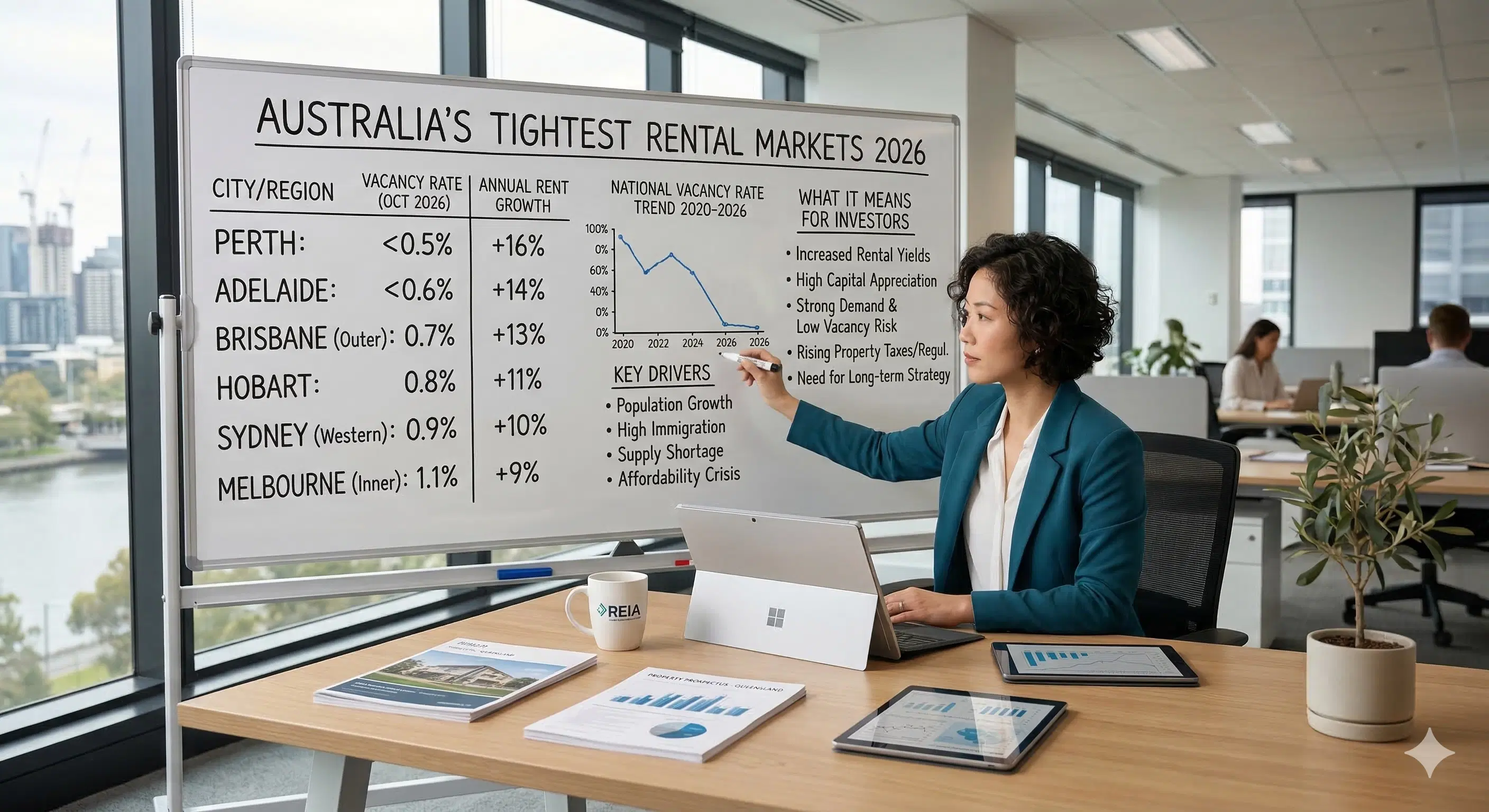
Australia's Tightest Rental Markets in 2026: Where Vacancy Rates Are Lowest and What It Means for Investors
The Rental Squeeze Isn’t Uniform — And That’s Where the Opportunity Lives
If you’ve read any property headline in the past two years, you’d think every rental market in Australia is impossibly tight. And while the national vacancy rate has been well below the long-term average, the reality on the ground is far more nuanced.
Key Takeaways
- National vacancy is below the long-term average, but tightness varies enormously by suburb
- Under 1% vacancy = extremely tight; 1–2% = strong landlord market; 2–3% = balanced
- Structural drivers (population growth, supply constraints) create more durable tightness than cyclical ones
- Tight rental markets deliver 5–10% annual rent growth vs 2–3% in balanced markets — compounding significantly over time
- Low vacancy alone doesn't guarantee a good investment — also check yields, prices, and economic diversity
Some markets genuinely have near-zero vacancy — landlords can fill properties within days of listing, often with multiple applications and rent offers above asking. Others have quietly loosened, with vacancy rates climbing back toward healthy levels as new supply comes online or population flows shift.
For property investors, the distinction matters enormously. Buying in a tight rental market means lower holding risk, stronger rental growth prospects, and better cash flow reliability. Buying in a market that was tight but is loosening could mean the opposite.
This guide explains how to read rental market tightness using actual data, what drives vacancy rates up and down, and how to distinguish between sustainably tight markets and those riding a temporary wave.
Understanding Vacancy Rates: The Core Metric
The vacancy rate measures the percentage of rental properties that are currently untenanted and available for lease. It’s the single most important indicator of rental market conditions.
What the Numbers Mean
Under 1%: Extremely tight. Tenants are competing fiercely for available properties. Landlords have significant pricing power. Rents are likely rising or about to rise. Properties typically lease within days of listing. This level of tightness is unusual and often indicates a structural supply shortage.
1–2%: Very tight. Strong landlord market. Properties lease quickly, and rent increases are common at renewal. Most investors consider this the “sweet spot” — high demand without the extreme scarcity that can create political pressure for intervention.
2–3%: Balanced. This is what housing economists consider a healthy equilibrium. Tenants have reasonable choice, landlords can find tenants without difficulty, and rents tend to track inflation rather than spike. Long-term average for Australian capital cities sits around 2.5–3%.
3–5%: Loosening. Tenants have more options. Landlords may need to adjust pricing or offer incentives (free week’s rent, allowing pets) to attract tenants. Rental growth slows or stalls.
Over 5%: Oversupplied. Significant tenant choice. Landlords face extended vacancy periods, and rents may decline. This level often appears in markets with recent apartment oversupply (inner-city high-rise precincts) or in resource towns during commodity downturns.
How Vacancy Is Measured
Different data providers measure vacancy slightly differently, which can create confusion:
- SQM Research tracks properties listed for rent on major portals for 21+ days as their “vacancy” measure
- Domain/CoreLogic use their own listing data with different counting methodologies
- State government bodies (like NSW’s REINSW) survey real estate agents directly
The absolute number matters less than the trend direction and the consistency of your data source. Pick one provider and track the trend over time rather than comparing numbers across providers.
What’s Driving Tight Rental Markets in 2026
Several structural and cyclical forces are keeping vacancy rates compressed in many Australian markets:
1. Population Growth Outpacing Housing Supply
Australia’s net overseas migration remains elevated, with most new arrivals initially entering the rental market. In capital cities — particularly Sydney, Melbourne, and Brisbane — the gap between population growth and new dwelling completions has widened. This is the fundamental driver of rental tightness: more people needing homes than homes being built.
The markets feeling this most acutely are those with both high migration intake and constrained development pipelines. Inner and middle-ring suburbs of Sydney and Melbourne, where zoning restricts new supply, are especially affected.
2. Construction Industry Constraints
The residential construction sector continues to face elevated costs and longer build times. Labour shortages, material costs, and insolvency events among builders have all contributed to a slower-than-expected supply pipeline. Dwelling approvals have recovered from pandemic lows but completions lag approvals by 18–24 months, meaning the supply response is still catching up.
3. The Investor Exodus (and Partial Return)
Between 2017 and 2022, regulatory changes (APRA lending restrictions, land tax increases in some states, and pandemic uncertainty) drove many smaller landlords out of the market. Fewer investor purchases meant fewer rental properties being added to the stock. While investor activity has picked up since 2023, the years of reduced investment are still reflected in today’s rental supply levels.
4. Short-Term Rental Conversion
Properties converted from long-term residential to short-term (Airbnb/Stayz) reduce the available rental stock in popular tourist and lifestyle areas. Coastal towns and inner-city hotspots are disproportionately affected. Some states are now regulating this more tightly, but the impact on existing stock is already baked in.
5. Household Formation Changes
Average household size continues to shrink as more Australians live alone or in smaller household configurations. This means the same population requires more dwellings — a structural demand increase that operates independently of population growth.
Where the Tightest Markets Are in 2026
Rather than giving you a list of specific suburbs (which would be outdated within weeks), here are the types of markets consistently showing the tightest rental conditions — and how to identify them in your own research.
Established Middle-Ring Capital City Suburbs
Suburbs 10–20km from CBDs in Sydney, Melbourne, and Brisbane with limited development potential (heritage areas, low-density zoning, geographic constraints) consistently show sub-1.5% vacancy rates. These suburbs attract a wide tenant demographic — young professionals, small families, downsizers — ensuring broad and consistent demand.
What to look for: Low vacancy rate combined with low days of supply, minimal new development approvals, and high owner-occupier ratios ratios (indicating limited rental stock relative to total dwellings).
Regional Centres With Diversified Employment
Larger regional cities — think Geelong, Wollongong, Newcastle, Sunshine Coast, Toowoomba, Ballarat — have experienced a structural uplift in demand since the pandemic-era migration shift. Many have vacancy rates below capital city averages because their development pipelines are smaller relative to demand growth.
What to look for: Population growth above the state average, employment across multiple industries (not dependent on a single employer or sector), and a university or hospital anchor that provides consistent rental demand.
Suburbs Near Major Infrastructure Projects
Areas around major transport, health, or education projects see rental demand spikes as construction workers and associated professionals move in. The Western Sydney Aerotropolis corridor, Brisbane’s Cross River Rail surrounds, and Melbourne’s Suburban Rail Loop stations are current examples.
What to look for: Funded (not just announced) infrastructure projects within 5–10km, combined with limited existing rental stock. Be cautious of areas where the infrastructure is also triggering large residential development — the supply response may absorb the demand increase.
Markets to Approach With Caution
Not all tight rental markets are good investments:
- Single-industry towns (mining, military, single-employer) can show sub-1% vacancy rates during boom periods but flip to 10%+ vacancy when conditions change. The yield looks incredible right up until it doesn’t.
- Student-dependent suburbs can see vacancy rates swing dramatically with international student enrolment policies, semester breaks, and university funding changes.
- Markets tight due to temporary factors (natural disaster displacement, major construction projects with a defined end date) will revert once the temporary driver passes.
How Tight Rental Markets Translate to Investment Returns
Rental Growth
The most direct benefit of investing in a tight rental market is rental growth. When vacancy is below 2%, landlords have pricing power at lease renewal and when re-leasing between tenants. Annual rent increases of 5–10% are common in genuinely tight markets, compared to 2–3% in balanced markets.
Compounded over a typical investment hold period (7–15 years), the difference is substantial. A property renting for $500/week with 7% annual growth reaches $983/week after 10 years. The same property with 3% growth reaches only $672/week. That’s a $16,000 per year difference in rental income by year 10.
Reduced Vacancy Risk
In tight markets, even a below-average property will find a tenant relatively quickly. In oversupplied markets, quality matters more — a dated kitchen or lack of parking can mean weeks of additional vacancy. For investors, lower vacancy risk means more predictable cash flow and fewer surprises.
Tenant Quality
When vacancy is low and landlords can choose from multiple applications, tenant quality tends to improve. Better tenants mean fewer maintenance issues, more reliable rent payments, and longer tenancies — all of which improve your net return.
Capital Growth Correlation
Tight rental markets often (but not always) correlate with capital growth. Low vacancy signals strong demand, and strong demand supports price appreciation. However, the correlation isn’t perfect — some high-yield tight markets have limited capital growth because the buyer pool is predominantly investors, not owner-occupiers. Look for tight rental markets where owner-occupier demand is also strong for the best capital growth correlation.
Using Data to Identify Tight Markets
Here’s a practical framework for using rental market data in your investment research:
Step 1: Screen by Vacancy Rate
Start with suburbs showing vacancy rates below 2%. This immediately filters out oversupplied markets and focuses your attention on areas with genuine rental demand.
Step 2: Check the Trend Direction
A suburb at 1.5% vacancy and falling is a very different proposition from one at 1.5% and rising. Falling vacancy suggests strengthening demand or tightening supply. Rising vacancy (even from a low base) could signal incoming supply or softening demand. Track the 12-month trend, not just the current snapshot.
Step 3: Cross-Reference With Supply Data
Check the development pipeline. A suburb with 0.8% vacancy today but 500 apartments approved and under construction may not be tight in 18 months. Days of supply — how long it would take to absorb all currently listed rental properties — adds crucial context to the vacancy rate.
Step 4: Verify Demand Drivers
Why is the market tight? Structural reasons (population growth, supply constraints, economic diversification) are more durable than cyclical ones (temporary construction boom, one-off migration event). Suburbs with multiple overlapping demand drivers offer the most sustainable tightness.
Step 5: Assess Rental Yield in Context
A tight market with 3% gross yield and one with 7% gross yield require very different investment strategies. The tight-and-low-yield market is likely a capital growth play with rental demand as a bonus. The tight-and-high-yield market is a cash flow opportunity. Neither is inherently better — it depends on your strategy.
Common Mistakes When Investing Based on Vacancy Data
Relying on a Single Data Point
One quarter’s vacancy rate is a snapshot, not a story. Markets can show temporarily low vacancy due to seasonal factors (January is typically tight as new migrants and students arrive) or data anomalies. Always look at 12-month rolling data.
Ignoring the “Why”
A vacancy rate of 0.5% in a coastal tourist town during peak season tells you nothing about what happens in winter. A vacancy rate of 0.5% in a diverse regional city with consistent year-round employment tells you a lot. Context determines whether tightness is structural or seasonal.
Confusing Tight Rental With Good Investment
A suburb can have extremely tight rental conditions and still be a poor investment if purchase prices are too high relative to rents (compressing yields), or if the market has limited capital growth potential. Vacancy rates are one input, not the whole equation.
Assuming Tightness Is Permanent
Markets cycle. Today’s 0.8% vacancy market could be tomorrow’s 3.5% vacancy market if a large development completes or a major employer leaves. The best protection is investing in markets where tightness is driven by durable structural factors rather than temporary conditions.
Frequently Asked Questions
Q: What is the current national vacancy rate in Australia (2026)?
A: The national vacancy rate remains well below the long-term average of 2.5–3%, though exact figures vary by data provider and methodology. However, the national average masks huge variation — some suburbs sit below 0.5% while others exceed 4%.
Q: Which types of suburbs have the tightest rental markets?
A: Three types consistently show sub-1.5% vacancy: established middle-ring capital city suburbs (10–20km from CBD) with limited development potential; regional centres with diversified employment and growing populations; and suburbs near major funded infrastructure projects.
Q: Can a tight rental market suddenly loosen?
A: Yes. Large development completions, major employer departures, or changes in migration policy can shift vacancy rates significantly within 12–18 months. The most sustainable tight markets are those driven by structural undersupply and multiple demand drivers, not temporary factors.
Q: How does low vacancy affect my investment returns?
A: Low vacancy delivers stronger rental growth (5–10% annually vs 2–3% in balanced markets), reduced vacancy periods between tenants, better tenant quality (you can be selective), and more predictable cashflow. Over a 10-year hold, compounded rental growth from a tight market can deliver $16,000+/year more income.
The Bottom Line
Australia’s rental market tightness is real but uneven. Smart investors look beyond the national vacancy headline to identify specific markets where structural supply-demand imbalances are creating genuine and durable rental demand.
The data to do this exists — vacancy rates, days of supply, population growth, employment diversity, and development pipelines can all be tracked at the suburb level. The investors who consistently find the best rental market opportunities are the ones who combine these data points rather than chasing a single metric.
Low vacancy isn’t a guarantee of investment success, but it’s one of the strongest foundations you can build a property investment on. When a market genuinely can’t supply enough rental housing to meet demand, almost everything else — rental growth, cash flow reliability, tenant quality — tends to follow.
Picki tracks vacancy rates, days of supply, rental yields, and population data for suburbs across Australia. Explore suburb-level rental market data and find where demand is genuinely outstripping supply.