

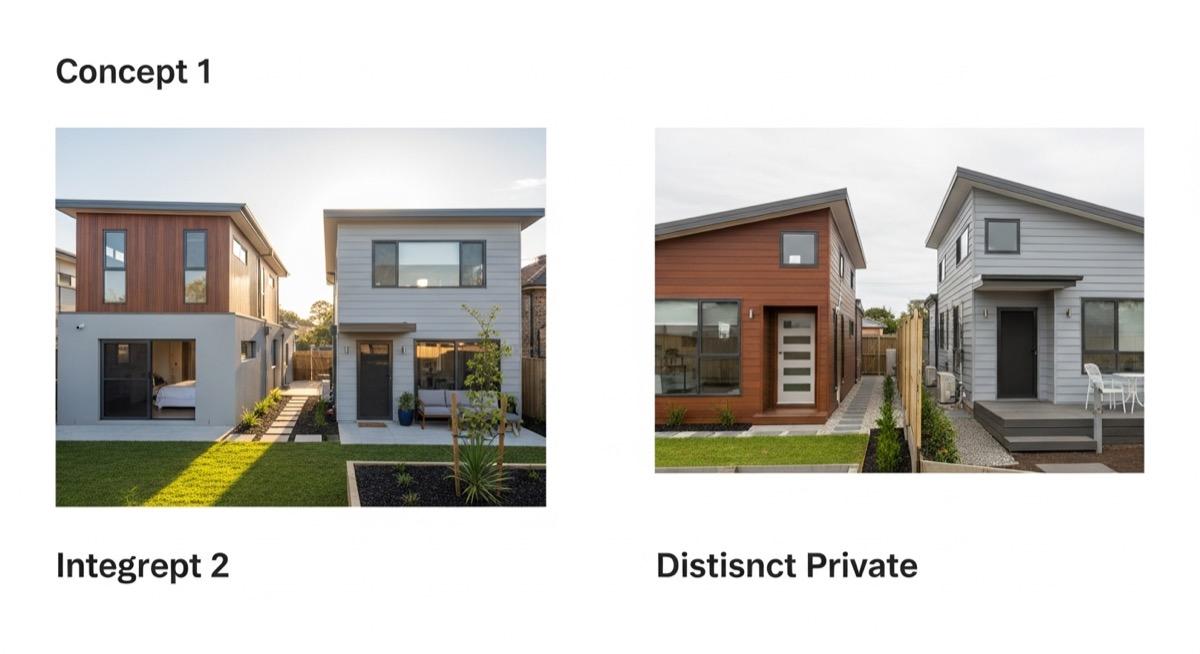
Dual Occupancy and Granny Flat Investment in Australia 2026: How to Boost Rental Returns on a Single Block
Dual occupancy development -- building a second dwelling on a single residential block -- has become one of the most talked-about strategies in Australian property investment. Whether it is a granny flat in the backyard, a duplex conversion, or a purpose-built dual-key home, the premise is straightforward: two income streams from one piece of land. But the reality of dual occupancy investing is considerably more nuanced than the spruikers suggest, and getting it wrong can be an expensive mistake.
Key Takeaways
- Dual occupancy can increase rental yields by 30-50% compared to a single dwelling on the same land
- Granny flat construction costs in Australia range from $120,000 to $220,000 in 2026 depending on size and specification
- Council regulations vary dramatically between local government areas -- some allow complying development approval in 20 days while others require a full DA taking 6-12 months
- Not every block is suitable: minimum lot size, setback requirements, and access provisions are critical constraints
- Dual occupancy works best in suburbs with strong rental demand, low vacancy, and median prices that leave room for the construction cost to be recouped
- According to Picki's analysis, suburbs scoring highly for rental demand alongside moderate price points offer the best dual occupancy opportunities
What Counts as Dual Occupancy in Australia?
Dual occupancy is a broad term that covers several different property configurations. Understanding the distinctions matters because each type has different council approval requirements, construction costs, financing implications, and rental outcomes.
Granny flats (secondary dwellings)
A self-contained dwelling built on the same lot as an existing house, typically in the backyard. In New South Wales, granny flats up to 60 square metres can be approved as complying development -- meaning no full development application is required, just a private certifier sign-off. This is one of the fastest and most cost-effective ways to add a second income stream to an existing investment property.
Duplex conversions
Converting an existing larger home into two separate dwellings, each with its own entrance, kitchen, bathroom, and living areas. This typically requires council approval and may involve strata titling or community title subdivision to create separate legal entities.
Knock-down-rebuild duplexes
Demolishing an existing dwelling and constructing two purpose-built homes (attached or detached) on the same lot. This is the most capital-intensive option but can create the most value -- particularly if the resulting properties can be individually titled and sold or held separately.
Dual-key homes
A single dwelling designed with two separate, self-contained living areas sharing a common wall but with independent entrances. These are increasingly common in new estates and can generate two rental incomes while being treated as a single property for council rates and strata purposes.
The Economics of Dual Occupancy: Running the Numbers
The financial case for dual occupancy rests on a simple equation: does the additional rental income justify the construction cost? Let us work through a realistic example for 2026.
Granny flat scenario
Consider a property in Blacktown NSW, purchased for $780,000 with an existing three-bedroom house renting for $550 per week. You build a two-bedroom granny flat for $180,000 (including site costs, connection fees, and landscaping). The granny flat rents for $380 per week.
Before granny flat: $550/week rent = $28,600/year gross rental income. Gross yield on $780,000 = 3.67%.
After granny flat: $930/week combined rent = $48,360/year gross rental income. Gross yield on $960,000 total investment = 5.04%.
That is a yield uplift of 137 basis points -- a significant improvement that can shift a property from negatively geared to neutral or even positively geared. The construction cost of $180,000 generates an additional $19,760 per year in rent, representing a 10.98% return on the granny flat investment alone.
Duplex scenario
A different investor buys a 700-square-metre block in a middle-ring Brisbane suburb for $650,000, demolishes the existing fibro house, and builds a duplex pair for $620,000 total construction cost (two three-bedroom, two-bathroom dwellings). Each unit rents for $520 per week.
Total investment: $1,270,000 (land + construction + holding costs during build).
Combined rent: $1,040/week = $54,080/year. Gross yield = 4.26%.
If the investor holds both, the yield is solid. But the real value creation often comes from the ability to sell one unit (once strata titled) to recover most of the outlay while keeping the other as a long-term hold. If each completed unit is worth $680,000, the combined end value is $1,360,000 -- creating $90,000 in equity above cost (before selling costs and tax).
Council Regulations: The Make-or-Break Factor
This is where dual occupancy gets complicated. Council regulations vary enormously between local government areas, and what is straightforward in one LGA can be virtually impossible in the next one over.
Key regulatory considerations
Minimum lot size. Most councils require a minimum lot size for dual occupancy approval. In Sydney's western suburbs, this can be as low as 450 square metres for a granny flat (complying development). In some Queensland councils, you may need 600 to 800 square metres for a secondary dwelling. Always check your specific local council requirements before purchasing.
Floor space ratios. Councils typically restrict the total floor area of all buildings on a lot to a percentage of the land area. A 0.5:1 floor space ratio on a 600-square-metre lot means total building area cannot exceed 300 square metres -- which needs to accommodate both the main dwelling and the secondary dwelling.
Setback and landscaping requirements. Minimum distances from boundaries, requirements for deep soil planting zones, and car parking provisions can significantly constrain what you can build -- particularly on smaller blocks.
Access provisions. Some councils require separate street access or a minimum-width driveway for the second dwelling. Corner blocks are often ideal for dual occupancy because they can provide independent street frontage to each dwelling.
NSW: The granny flat capital
New South Wales has the most permissive granny flat regulations in Australia. Under the State Environmental Planning Policy (Affordable Rental Housing), granny flats up to 60 square metres can be approved as complying development on lots of 450 square metres or more in most residential zones. The approval process takes approximately 10 to 20 business days through a private certifier, compared to 3 to 12 months for a full development application.
Victoria: Dual occupancy under new planning rules
Victoria's planning reforms have made dual occupancy increasingly accessible, particularly in the General Residential Zone. Properties in established suburbs like those across the City of Wyndham can often accommodate a second dwelling, though the approval process typically requires a full planning permit application.
Queensland: Unit-based approach
Queensland treats secondary dwellings differently depending on the council. Some, like the Brisbane City Council, allow secondary dwellings of up to 80 square metres on lots over 400 square metres. Others have more restrictive policies. The key is to check the specific planning scheme for your target LGA.
Finding the Right Suburb for Dual Occupancy
Not every suburb is suitable for dual occupancy investment. The ideal suburb combines several characteristics:
Strong rental demand. Both dwellings need tenants. Suburbs with low vacancy rates (below 2%) across multiple property types are ideal. If the area has strong demand for both houses and smaller dwellings, your dual occupancy is more likely to stay fully tenanted.
Moderate price point. The economics of dual occupancy work best in suburbs where the purchase price leaves sufficient room for the construction cost without pushing total investment beyond what the rental income can service. Suburbs in the $500,000 to $900,000 median range tend to be the sweet spot for granny flat additions.
Appropriate lot sizes. The suburb needs to have a meaningful proportion of blocks above the minimum lot size threshold. Older established suburbs with larger blocks (600 square metres and above) are typically better candidates than newer estates where blocks may be 350 to 450 square metres.
Supportive council planning policy. Research the specific LGA's planning scheme before committing. Some councils actively encourage gentle densification while others resist it.
Tenant demographic alignment. The suburb should have demand for the type of tenant a secondary dwelling attracts -- typically singles, couples, or small families. Suburbs near hospitals, universities, transport hubs, or employment centres often have diverse tenant pools that suit dual occupancy configurations.
Financing Dual Occupancy: What Lenders Want to See
Financing is one of the trickiest aspects of dual occupancy. Lenders treat these projects differently depending on the type of development and whether you are adding to an existing property or building from scratch.
Granny flat on an existing property
If you already own the property, you can typically fund a granny flat through a construction loan or by accessing equity. Most lenders will not formally value the granny flat until it is complete, but some will provide a preliminary valuation based on plans and specifications. The additional rental income from the granny flat is generally recognised by lenders when refinancing after completion, improving your cashflow position.
Duplex construction
Purpose-built duplexes typically require a construction loan with progressive drawdowns tied to build stages. Lenders will usually fund 70-80% of the total project cost (land plus construction). You will need a quantity surveyor's report and full council-approved plans before the loan is approved. The good news is that once complete and strata titled, each unit can be valued independently -- often creating equity above the total cost.
Key lending considerations
- Not all lenders are comfortable with dual occupancy construction -- specialist or second-tier lenders may offer better terms
- Loan-to-value ratios are typically more conservative for construction (70-80% LVR) compared to established property purchases (up to 90-95%)
- Build time matters: most construction loans have a maximum build period of 12 months, and delays can trigger costly extensions
- Some lenders will not recognise projected rental income from a dwelling that does not yet exist, which can create a serviceability gap
Tax Implications of Dual Occupancy
The tax treatment of dual occupancy depends on your specific situation, and professional advice is essential. However, here are the key principles investors should understand.
Construction costs are depreciable. A brand-new granny flat or duplex qualifies for full building depreciation at 2.5% per year over 40 years, plus accelerated depreciation on fixtures and fittings. On a $180,000 granny flat, the building depreciation alone is $4,500 per year -- a meaningful tax deduction that improves after-tax returns.
Capital gains tax on subdivision. If you subdivide and sell one dwelling, capital gains tax applies to the profit. If the property was your principal place of residence before you added the second dwelling, the CGT calculation can be complex -- the main residence exemption may apply to the original dwelling but not the new one.
GST considerations. New residential property sales can trigger GST obligations. If you build and sell a new dwelling, the ATO may consider you to be carrying on an enterprise, which means GST registration and payment obligations. This is particularly relevant for duplex developers who plan to sell one unit.
Risks and Pitfalls to Watch For
Overcapitalisation. The most common mistake is spending too much on the secondary dwelling relative to what the area can command in rent. A $250,000 luxury granny flat in a suburb where one-bedroom units rent for $300 per week will take decades to pay for itself. Keep construction costs proportionate to rental returns.
Construction cost blowouts. Building costs in Australia have increased by approximately 30% since 2020, and fixed-price contracts often contain variation clauses that can erode your budget. Get at least three quotes, include a 10-15% contingency buffer, and use builders experienced in dual occupancy construction.
Tenant management complexity. Two dwellings on one lot means two tenants sharing common areas -- driveways, gardens, bins. Clear boundary definitions in the lease, separate utility metering, and thoughtful design that maximises privacy are essential to avoid disputes.
Insurance implications. Standard landlord insurance may not cover a second dwelling on the same title. You need to ensure both dwellings are adequately covered, and some insurers charge significantly more for dual occupancy properties.
Resale market. Properties with granny flats can be harder to sell because they appeal to a narrower buyer pool -- primarily investors. If you need to sell, the property may take longer to move than a standard house, and some buyers may actually see the granny flat as a negative (reduced yard space, privacy concerns).
Is Dual Occupancy Right for Your Strategy?
Dual occupancy works best for investors who prioritise cashflow improvement and are willing to take on the complexity of construction and council approvals. It is particularly well-suited to:
- Investors who already own a property with a large enough block to add a granny flat -- this is the lowest-risk entry point
- Experienced investors comfortable managing construction projects who want to manufacture equity through development
- Cashflow-focused investors who need to improve the yield on an existing property to improve their borrowing capacity for the next purchase
It is less suitable for first-time investors who may underestimate the complexity, investors in high-price suburbs where construction costs are disproportionate to rental returns, or anyone looking for a purely passive investment -- dual occupancy requires active management, at least during the construction and leasing phase.
Before committing to a dual occupancy strategy, use data to identify suburbs where the economics stack up. Platforms like Picki let you filter suburbs by yield potential, vacancy rates, and median prices to find areas where the numbers work. Compare options across different regions using regional and metro data to identify where dual occupancy delivers the best risk-adjusted returns.
Frequently Asked Questions
How much does it cost to build a granny flat in Australia in 2026?
Granny flat construction costs range from $120,000 for a basic one-bedroom design to $220,000 or more for a two-bedroom dwelling with higher-end finishes. The average cost for a 50 to 60 square metre two-bedroom granny flat sits around $160,000 to $180,000, including site preparation, council fees, utility connections, and landscaping. Costs vary significantly by state and location -- Sydney tends to be 10-15% more expensive than Brisbane or Perth.
Do I need council approval to build a granny flat?
In New South Wales, granny flats up to 60 square metres can be approved as complying development without a full DA, provided the property meets certain criteria (lot size, zoning, bushfire risk). In other states, you typically need a development application or planning permit from your local council. Approval timeframes range from 10 business days (NSW complying development) to 6-12 months (full DA in some councils).
Can I subdivide and sell the granny flat separately?
Subdivision rules vary by state and council. In NSW, most granny flats built under the Affordable Rental Housing SEPP cannot be subdivided from the main dwelling (they must remain on the same title). In some Queensland and Victorian councils, secondary dwellings can be strata titled and sold independently, but this typically requires separate services, access, and compliance with subdivision standards. A town planner can advise on the specific rules for your property.
How much extra rent can I expect from a granny flat?
Granny flat rental income depends entirely on location and size. In western Sydney suburbs, a two-bedroom granny flat typically rents for $350 to $420 per week in April 2026. In Brisbane's middle ring, expect $320 to $380 per week. In regional areas, rents may be $250 to $320 per week. As a rule of thumb, a well-located granny flat generates 30-50% of the main dwelling's rental income.
Does a granny flat add value to my property?
A granny flat typically adds 60-80% of its construction cost to the property's market value. So a $180,000 granny flat might increase the property's valuation by $110,000 to $145,000. The value uplift varies by location and quality -- in high-demand rental areas, the capitalised value of the additional rental income can push the uplift closer to 100% of cost. The real value, however, is usually in the ongoing rental income rather than the capital value increase. Check your target suburb's investment metrics on Picki to assess whether the economics work in your specific area.