


How Picki's Land Score Works: Why Land Size Relative to Your Neighbourhood Matters for Property Investment
How Picki's Land Score Works: Why Land Size Relative to Your Neighbourhood Matters for Property Investment
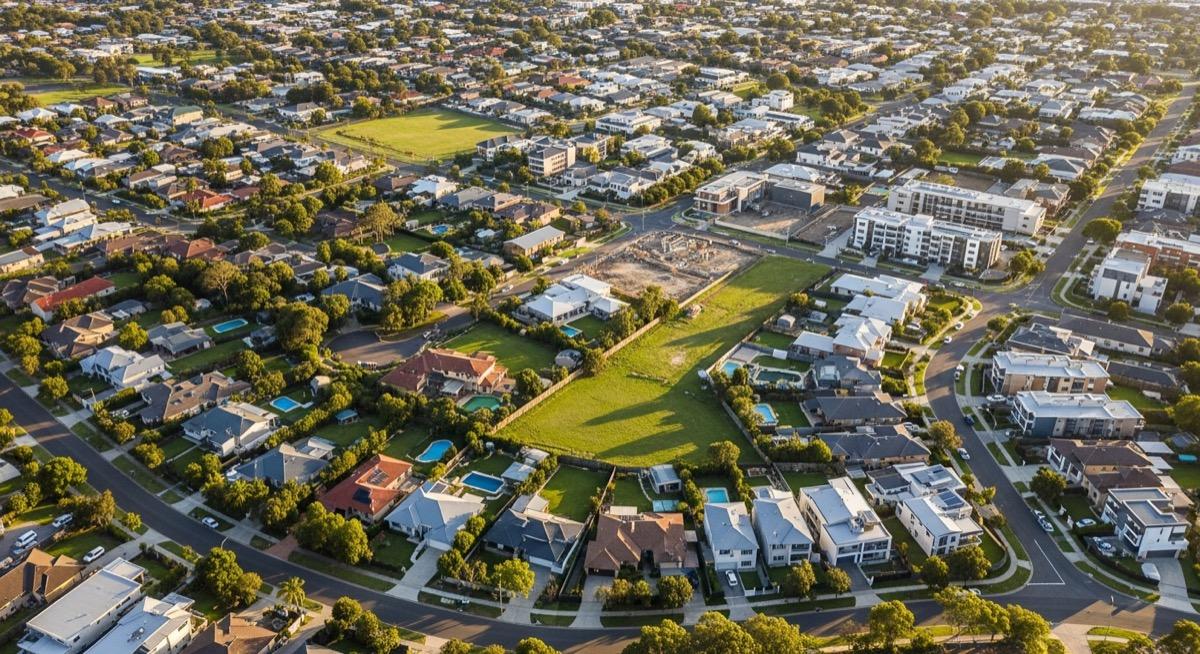
When most property investors evaluate a potential purchase, they look at the land size in absolute terms â 600 square metres sounds good, 300 sounds small. But what if that 600 sqm block is in a neighbourhood where the median lot is 900 sqm? Or what if that 300 sqm block sits in an area where most properties are townhouses on 200 sqm? Context changes everything, and that's exactly what Picki's Land Score is designed to measure.
What Is the Land Score?
Picki's Land Score is a property-level metric scored from 0 to 100 that measures how optimal a property's land size is relative to other properties in its immediate neighbourhood. Specifically, it compares your property's land area against the median land size within the same SA1 â the smallest geographic unit used by the Australian Bureau of Statistics, typically covering around 200 to 800 dwellings.
According to Picki's analysis, properties that score highest on the Land Score are those with land sizes closest to the neighbourhood median. The score decreases as the property's land size diverges â either larger or smaller â from what's typical in that specific micro-location.
Why the Neighbourhood Median Matters More Than Absolute Size
Here's a scenario that illustrates why relative land size matters. Consider two properties, both on 450 sqm blocks:
Property A sits in an established inner-ring suburb where the SA1 median lot size is 500 sqm. Most homes are similar-sized detached houses. The 450 sqm block is only slightly below the median â its Land Score would be high, perhaps 80 or above.
Property B is in a new master-planned estate where most lots are 300â350 sqm. The 450 sqm block is significantly above the SA1 median. While a bigger block sounds appealing, this property may actually have a lower Land Score because it's an outlier in its context.
Why does this matter for investors? Because when comparing investment properties across different suburbs, the buyer pool for resale is shaped by what's normal in that neighbourhood. Properties that fit the local profile tend to attract more interest at resale, which supports both capital growth potential and liquidity.
How the Land Score Is Calculated
Picki data shows that the Land Score calculation follows a bell-curve distribution centred on the SA1 median land size. Here's how the scoring broadly works:
The score uses the SA1 boundary because it captures the most granular neighbourhood data available. Two properties in the same suburb but different SA1s may have very different Land Scores if their immediate neighbourhoods have different housing profiles.
What a High Land Score Tells You
A high Land Score (70+) signals several positive attributes:
Alignment with local demand. The property matches what buyers and renters in that micro-location expect. In suburbs like Blacktown, NSW, where most houses sit on similar-sized lots, a property matching the median is easier to value, easier to rent, and easier to sell.
Accurate comparable sales. When your property's land size is typical for the area, bank valuers and automated valuation models have more comparable sales to draw from. This can reduce the risk of valuation surprises during finance approval.
Predictable holding costs. Properties on standard-sized lots tend to have predictable council rates, maintenance costs, and insurance premiums relative to their neighbours.
What a Low Land Score Tells You
A low Land Score (below 50) doesn't automatically mean avoid the property. It means the land size is unusual for the neighbourhood, and you should investigate why.
Oversized lots might indicate subdivision potential â particularly valuable in areas with favourable zoning for higher density development. However, they also carry higher land tax, potentially higher maintenance costs, and may sit in a price bracket with fewer comparable sales.
Undersized lots might be battle-axe blocks, corner carve-outs, or newer subdivisions within established areas. These properties can offer strong rental yields due to lower purchase prices, but they may face resistance from owner-occupier buyers who prefer more traditional lot sizes.
How Land Score Works With Other Picki Metrics
Land Score is most powerful when read alongside two related metrics:
Land-to-Asset Ratio measures what percentage of a property's total value is attributable to the land versus the building. A property can have a high Land Score (perfectly sized for the area) but a low Land-to-Asset Ratio (most of the value is in the building, not the land). Understanding both helps you assess long-term capital growth drivers.
Configuration Score measures how well the property type (house, unit, townhouse) matches local demand. A property might have a perfect Land Score but a low Configuration Score if it's the wrong dwelling type for the area. For more on this relationship, see our guide to how dwelling type affects investment performance.
Together, these three metrics answer a fundamental investment question: Does this property fit its neighbourhood? Properties that score well across all three tend to have broader buyer appeal, more reliable valuations, and stronger demand fundamentals.
Practical Examples: Land Score in Action
To illustrate how the Land Score works in practice, consider these real-world scenarios:
Scenario 1: Growth corridor suburb. In Tarneit, VIC, most new estates feature lots between 300â450 sqm. A property on a 380 sqm lot would likely score 85+ on Land Score, while a rare 700 sqm lot in the same SA1 might score below 50. The larger lot isn't necessarily worse â it just requires different analysis.
Scenario 2: Established regional suburb. In Kirwan, QLD, the typical lot size skews larger â often 600â800 sqm. Here, a 650 sqm block would score very high, while a 300 sqm townhouse lot might score lower because it's atypical for the immediate area.
Scenario 3: Coastal lifestyle market. In Mandurah, WA, lot sizes vary considerably between waterfront areas and inland estates. The Land Score accounts for this by using SA1-level data, so a waterfront property is compared against other waterfront properties, not the suburb average.
Using Land Score in Your Investment Research
Here's how to practically apply the Land Score when evaluating potential investments:
Common Misconceptions About Land Size and Investment
"Bigger is always better." This is the most common misconception in Australian property investment. While land appreciates and buildings depreciate, an oversized lot in a neighbourhood of smaller lots can actually underperform because it sits in a higher price bracket with fewer comparable buyers. The data consistently shows that depreciation benefits and land value growth are context-dependent.
"Land Score doesn't matter for units." Even for apartments and units, Picki calculates a Land Score based on the proportional land allocation. A unit in a building that sits on generous common land relative to the area norm will score differently from one in a high-rise tower.
"I should only buy high Land Score properties." Not necessarily. The Land Score is a risk and fit indicator, not a quality indicator. A low Land Score property might be exactly what a sophisticated investor wants â particularly if they're targeting subdivision, development, or a market segment that values unusual lot sizes.
Frequently Asked Questions
What is Picki's Land Score and how is it calculated?
Picki's Land Score is a metric from 0 to 100 that measures how well a property's land size matches the median land size in its Statistical Area Level 1 (SA1). Properties closest to the neighbourhood median score highest. The score uses ABS geographic boundaries to ensure comparisons are made against genuinely local properties, not broad suburb averages.
Is a higher Land Score always better for property investment?
A higher Land Score indicates the property fits its neighbourhood, which generally supports broader buyer appeal and more reliable valuations. However, experienced investors may deliberately target lower Land Score properties that represent subdivision or development opportunities. The score is a risk indicator, not a quality judgment.
How does Land Score differ from Land-to-Asset Ratio?
Land Score measures whether a property's land size is typical for its neighbourhood (a fit metric). Land-to-Asset Ratio measures what proportion of the property's value comes from land versus building (a growth driver metric). A property can have a high Land Score but low Land-to-Asset Ratio â for example, a standard-sized lot with a recently built premium home.
Can I filter properties by Land Score on Picki?
Yes. Picki displays the Land Score on individual property analysis pages, and you can use it as one of several filters when comparing properties within and across suburbs. For a full walkthrough of how to use these tools, see our guide to comparing suburbs side by side.
Does Land Score change over time?
Yes, though slowly. As new developments change the housing mix in an SA1 (for example, large lots being subdivided into smaller ones), the neighbourhood median shifts, which can change the Land Score for existing properties. This typically happens over years, not months, and reflects genuine changes in the neighbourhood profile.
Want to see Land Scores for properties you're researching? Start your free trial on Picki and explore property-level metrics across every suburb in Australia.