

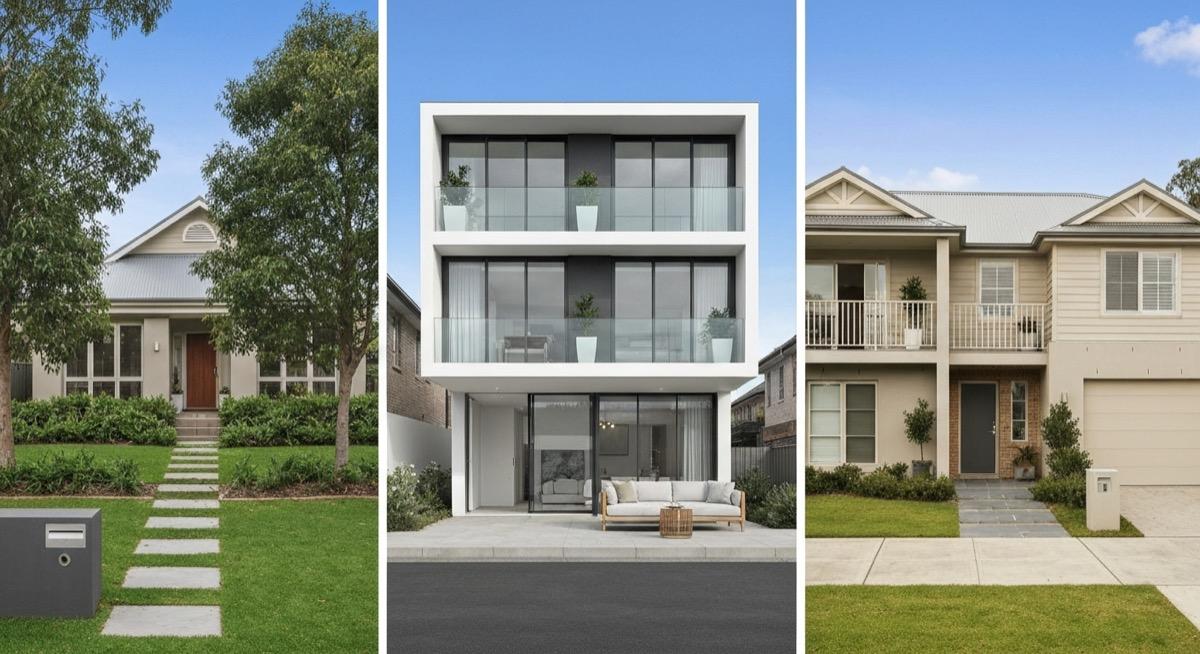
Houses vs Units vs Townhouses: How Dwelling Type Affects Property Investment Performance in Australia
When researching suburbs for property investment, one of the most overlooked data points is the dwelling type composition — the mix of houses, units, townhouses, and apartments within a suburb. This single metric can tell you more about a suburb's investment dynamics than almost any headline price figure.
Two suburbs with identical median prices can deliver wildly different investment outcomes depending on their dwelling mix. A suburb dominated by detached houses behaves fundamentally differently from one split between houses and apartments. The rental market, vacancy rates, capital growth patterns, and even the type of tenant you attract all shift based on what's actually been built in the area.
Key Takeaways
- Dwelling type composition directly affects rental demand, vacancy rates, and capital growth patterns within a suburb
- Detached houses have delivered average annual capital growth of 6.8% nationally over the past 30 years, compared to 5.1% for units — but units often offer higher gross rental yields
- Suburbs with a high proportion of new apartments (above 40% unit stock) tend to have higher vacancy rates and more volatile rental returns
- Townhouses occupy a middle ground, combining elements of both houses and units in terms of yield, growth, and tenant appeal
- Picki data shows dwelling-level metrics for each suburb, helping investors understand how different property types perform in the same location
Why Dwelling Type Matters More Than You Think
Most property investors start their research with price. What can I afford? What's the median? But price without context is incomplete. A $600,000 property in one suburb might be a three-bedroom house on 600 square metres. In another suburb, the same $600,000 buys a two-bedroom apartment in a high-rise complex with a pool and gym.
These two properties will behave differently in almost every measurable way: different tenants, different holding costs, different capital growth trajectories, different depreciation profiles, and different risk characteristics. Understanding the dwelling mix of a suburb helps you anticipate these differences before you buy.
According to the 2021 Census, approximately 72% of Australian dwellings are detached houses, 14% are apartments (in buildings of four or more storeys), and the remainder are townhouses, semi-detached dwellings, and low-rise apartments. But these national averages mask enormous variation at the suburb level. Some inner-city suburbs are 90%+ apartments. Many outer suburban areas are 95%+ houses. The investment dynamics of each are fundamentally different.
Detached Houses: The Growth Engine
Detached houses have been the backbone of Australian property wealth creation for decades. There's a structural reason for this: land appreciates while buildings depreciate. A house on its own block gives you direct exposure to land value — and land in well-located areas becomes scarcer over time as populations grow.
Capital Growth
CoreLogic data shows that national house values grew by an average of 6.8% per year over the three decades to 2025, compared to 5.1% for units. This 1.7 percentage point gap might seem small, but compounded over 20 years it's enormous. A $500,000 house growing at 6.8% is worth approximately $1.87 million after 20 years. The same starting value growing at 5.1% reaches approximately $1.36 million. That's a $510,000 difference from the same starting point.
The gap has been even wider in capital cities. In Sydney, the house-unit growth gap exceeded 2 percentage points annually over the 2010–2025 period, driven by constrained land supply, strong population growth, and planning restrictions that limited new detached housing in established suburbs.
Rental Yield
The trade-off is yield. Houses typically offer lower gross rental yields than units because their purchase prices are higher relative to the rents they command. Nationally, average gross yields for houses sit around 3.8–4.2% in capital cities, compared to 4.5–5.5% for units.
This creates the classic capital growth vs cashflow trade-off that every investor must navigate. Houses tend to be negatively geared (costing you money each year before tax benefits), while well-chosen units can be cashflow-neutral or positive from day one.
Where Houses Dominate
Suburbs where detached houses make up 85%+ of dwelling stock tend to share common characteristics: family-oriented demographics, lower density, longer average hold periods, and more stable price movements. These suburbs — common across outer metropolitan and regional areas — often show less price volatility but also less rental tightness.
Areas like Blacktown in Western Sydney illustrate this dynamic. With a predominantly house-based dwelling stock, the suburb attracts family tenants seeking space, proximity to schools, and relative affordability. The rental market tends to be steady rather than volatile, with vacancy rates that track broader economic conditions rather than swinging with construction cycles.
Units and Apartments: Higher Yield, Different Risks
Units and apartments serve a different market and carry a different risk profile. Understanding these differences is essential if you're considering investing in strata-titled property.
Capital Growth
The lower long-term capital growth of units compared to houses is well-documented, but the reasons are worth understanding because they don't apply uniformly.
The primary driver is land content. A unit in a 100-lot apartment complex gives you 1/100th of the building's land value. Even if the land appreciates strongly, your share of that appreciation is diluted across all lot owners. Meanwhile, the building itself — which represents the majority of your unit's value — depreciates.
The second factor is supply elasticity. When demand rises in a suburb with available development sites, developers can build more apartments relatively quickly. This new supply moderates price growth. In contrast, there's no way to "build more houses" in an established suburb with limited vacant land — supply is fundamentally constrained.
However, not all unit markets are the same. Older-style units in small blocks (6–12 apartments) on larger land parcels can and do deliver strong capital growth, particularly in inner and middle-ring suburbs where the land component remains significant. The units that tend to underperform are those in large, high-rise developments where land dilution is greatest and supply response is strongest.
Rental Yield and Demand
Units typically offer higher gross yields, but the picture for net yields is more nuanced once you account for strata fees and other holding costs. A unit with a 5.2% gross yield and $5,000/year in strata fees might deliver a net yield comparable to a house with a 4.0% gross yield and minimal body corporate costs.
The tenant profile for units differs from houses. Units tend to attract singles, couples, young professionals, students, and downsizers — demographics that are more mobile and typically have shorter tenancy durations. Higher turnover means more vacancy periods, more letting fees, and more wear-and-tear costs over time.
Oversupply Risk
The biggest risk specific to unit markets is oversupply. When too many apartments are built in one area, the result is rising vacancy rates, downward pressure on rents, and stagnant or falling values. This has played out in several Australian markets over the past decade.
Melbourne's CBD apartment market experienced vacancy rates above 8% during COVID, and several inner Brisbane postcodes saw similar dynamics during the 2016–2019 apartment construction boom. Even as these markets have recovered, the experience highlights a risk that largely doesn't apply to established house markets.
When evaluating unit-heavy suburbs, checking vacancy rate trends is critical. A suburb with 40%+ unit stock and a rising vacancy rate may be heading into an oversupply cycle — even if headline median prices look stable.
Townhouses: The Middle Ground
Townhouses have emerged as an increasingly important part of the Australian property landscape, particularly in middle-ring suburbs where developers are replacing older detached houses with two or three townhouses on the same lot.
The Best of Both?
Townhouses offer a blend of characteristics from both houses and units. They typically have more land content than apartments (though less than detached houses), their own street frontage, often a small private courtyard, and lower strata fees than apartment complexes. Many newer townhouses are built without common facilities like pools and gyms, keeping body corporate costs to $500–$1,500 per quarter.
Capital growth for townhouses has historically sat between houses and units — outperforming high-rise apartments but trailing detached houses. The land component, while smaller than a house, is still meaningful, especially in suburbs where the underlying land value is high.
Tenant Appeal
Townhouses appeal to a broader demographic than apartments. Small families, professional couples, and downsizers who want some outdoor space but don't want the maintenance of a full house are all drawn to the townhouse format. This broader appeal can translate to lower vacancy rates and longer tenancies compared to apartments.
In suburbs like Point Cook in Melbourne's west, townhouses have become a significant part of the dwelling mix as the area has matured. Newer townhouse developments in these growth corridors offer relatively affordable entry points with modern construction and low-maintenance living — characteristics that attract both owner-occupiers and tenants.
The Depreciation Advantage
Newer townhouses (built after 1985) can offer significant tax depreciation benefits. The building construction costs, fixtures, and fittings can all be depreciated, reducing your taxable income and improving after-tax cashflow. This is the same depreciation benefit available for any newer property, but townhouses often offer a better balance of depreciation value and land content than new apartments.
How Dwelling Mix Shapes Suburb Dynamics
The dwelling type composition of a suburb doesn't just affect individual property performance — it shapes the entire market dynamic of the area.
High-House Suburbs (85%+ Detached Houses)
These suburbs tend to have:
- Lower vacancy rates (family tenants stay longer)
- More stable price movements (less new supply entering the market)
- Lower gross yields but stronger capital growth
- Older demographic profiles (established families, long-term residents)
- Higher owner-occupier ratios (families prefer to own houses)
The owner-occupier ratio in these suburbs is typically above 65%, which research suggests correlates with price stability and consistent demand.
Mixed Suburbs (50–70% Houses, 30–50% Units/Townhouses)
These suburbs tend to have:
- More diverse tenant and buyer pools
- Greater price dispersion (wider gap between cheapest and most expensive properties)
- More active development pipelines (ongoing subdivision and infill development)
- Moderate vacancy rates, influenced by the balance of new and established stock
Mixed suburbs can offer good opportunities for investors who understand the internal dynamics — but you need to be specific about which property type you're targeting. The median price in these suburbs can be particularly misleading because it blends values across fundamentally different property types.
High-Unit Suburbs (60%+ Apartments/Units)
These suburbs tend to have:
- Higher gross yields but more volatile returns
- Higher vacancy rate sensitivity to economic conditions and migration patterns
- More new supply risk (development approvals can change the market rapidly)
- Lower owner-occupier ratios (more investors and renters)
- Shorter average tenancy durations
Inner-city suburbs in Sydney, Melbourne, and Brisbane fall into this category. They can deliver strong rental returns in tight markets but are more exposed to demand shocks — as COVID demonstrated when international student and migration flows halted.
Using Dwelling Type Data in Your Investment Research
Here's a practical framework for incorporating dwelling type analysis into your suburb research:
Step 1: Identify the dwelling mix. What percentage of the suburb's stock is houses vs units vs townhouses? This tells you the basic market structure you're entering.
Step 2: Match to your strategy. If you're seeking capital growth, lean toward suburbs with high house proportions and limited development pipeline. If you're seeking cashflow, unit-heavy suburbs may offer better yields — but check the vacancy rate and supply pipeline first.
Step 3: Compare within the suburb. Don't just look at suburb-level medians. Compare yield, growth, and vacancy data for each dwelling type separately. Picki's suburb analysis breaks down performance metrics by property type, so you can see how houses, units, and townhouses each perform within the same location.
Step 4: Check the trend. Is the dwelling mix changing? A suburb transitioning from predominantly houses to a mix of houses and townhouses (common in middle-ring Melbourne and Sydney suburbs) may see its dynamics shift over time. Increased density can improve amenity and transport links, but also increase supply and change the demographic profile.
Step 5: Factor in holding costs. Different dwelling types carry different cost structures. Houses have maintenance and gardening costs but no strata fees. Units have strata fees that can significantly reduce net yields. Townhouses sit in between. Make sure your rental income estimates account for these differences.
Real-World Examples: Same Suburb, Different Outcomes
Consider a middle-ring Sydney suburb with a 60/40 house-unit split. A three-bedroom house might sell for $1.2 million and rent for $750/week (gross yield 3.25%). A two-bedroom unit in the same suburb might sell for $650,000 and rent for $550/week (gross yield 4.4%).
On gross yield alone, the unit wins comfortably. But factor in $6,000/year in strata fees, shorter tenancies (averaging 14 months vs 24 months for the house), and weaker capital growth (4% vs 6% historically for this suburb), and the picture changes.
Over a 10-year hold:
- The house grows from $1.2M to approximately $2.15M — a $950,000 gain
- The unit grows from $650K to approximately $960K — a $310,000 gain
- The house costs more to hold each year (higher mortgage), but the cumulative capital gain dwarfs the unit's cashflow advantage
This doesn't mean units are always worse — in suburbs where house prices are inaccessible, or where unit-specific demand is strong (inner-city, near transport hubs, near universities), units can be excellent investments. The point is that dwelling type fundamentally changes the investment equation, and you need to run the numbers for each type separately.
The Emerging Townhouse Opportunity
One trend worth watching is the growing townhouse segment in Australian property markets. Planning reforms in most states are encouraging "missing middle" housing — medium-density development that fills the gap between detached houses and high-rise apartments.
In suburbs like Tarneit and other Melbourne growth corridors, new townhouse developments are being delivered at price points 20–30% below detached houses with comparable bedroom counts. For investors, this creates an entry point into these growing suburbs with potential for both yield and growth — provided strata fees remain manageable and the development pipeline doesn't flood the market.
The key with townhouses is selectivity. Look for small-scale complexes (under 20 lots) with minimal common facilities, in suburbs where the underlying market fundamentals — population growth, employment, infrastructure investment — support long-term demand.
Bringing It All Together
Dwelling type is not a secondary data point — it's a primary driver of investment performance. The same suburb can offer vastly different returns depending on whether you buy a house, a unit, or a townhouse. Understanding the dwelling composition of your target suburb, and how each property type performs within it, is one of the most practical steps you can take to improve your investment decision-making.
Picki's suburb research pages break down key metrics — rental yields, vacancy rates, price trends, and holding cost estimates — by dwelling type, giving you the granular view needed to compare apples with apples. It's the kind of dwelling-level analysis that turns broad suburb research into specific, actionable investment insights.
Frequently Asked Questions
Do houses always outperform units for capital growth?
Over the long term (20+ years), detached houses have consistently outperformed units for capital growth nationally, averaging approximately 6.8% annual growth vs 5.1% for units. However, there are exceptions. Well-located units in supply-constrained areas (art deco apartments in established inner suburbs, boutique blocks on large land parcels) can deliver house-like capital growth. The key factor is land content — the higher the land-to-building value ratio, the stronger the long-term growth potential.
Are townhouses a good investment in 2026?
Townhouses can be excellent investments when selected carefully. They offer a balance of land content (supporting capital growth), reasonable yields, and broader tenant appeal than apartments. In 2026, townhouses in growth corridors and middle-ring suburbs with strong fundamentals represent a compelling option, particularly for investors priced out of the detached house market. Look for small complexes with low strata fees and in suburbs with tight vacancy rates.
How do strata fees affect unit investment returns?
Strata fees directly reduce your net rental yield. Annual strata fees of $4,000–$8,000 are common for apartments, and can reduce gross yields by 0.7–1.5 percentage points. A unit with a 5.2% gross yield and $6,000 in annual strata fees might deliver a net yield comparable to a house with a 3.8% gross yield and no strata fees. Always calculate net yield inclusive of all holding costs before comparing different dwelling types.
What dwelling type has the lowest vacancy rates?
Detached houses generally have lower vacancy rates than units, primarily because house tenants (often families) tend to stay longer and turn over less frequently. Average tenancy durations for houses are typically 18–24 months compared to 12–16 months for apartments. Suburbs with high house proportions (above 85%) consistently show lower vacancy rates than unit-dominated suburbs, though local market conditions always play a role.
Should I look at dwelling type data when comparing suburbs?
Absolutely. Comparing suburbs without considering dwelling type composition is like comparing fruit without distinguishing apples from oranges. A suburb with a $700,000 median dominated by houses and a suburb with a $700,000 median dominated by apartments are fundamentally different investment propositions. Always check the dwelling mix and compare metrics for your target property type specifically, not just suburb-level aggregates.