

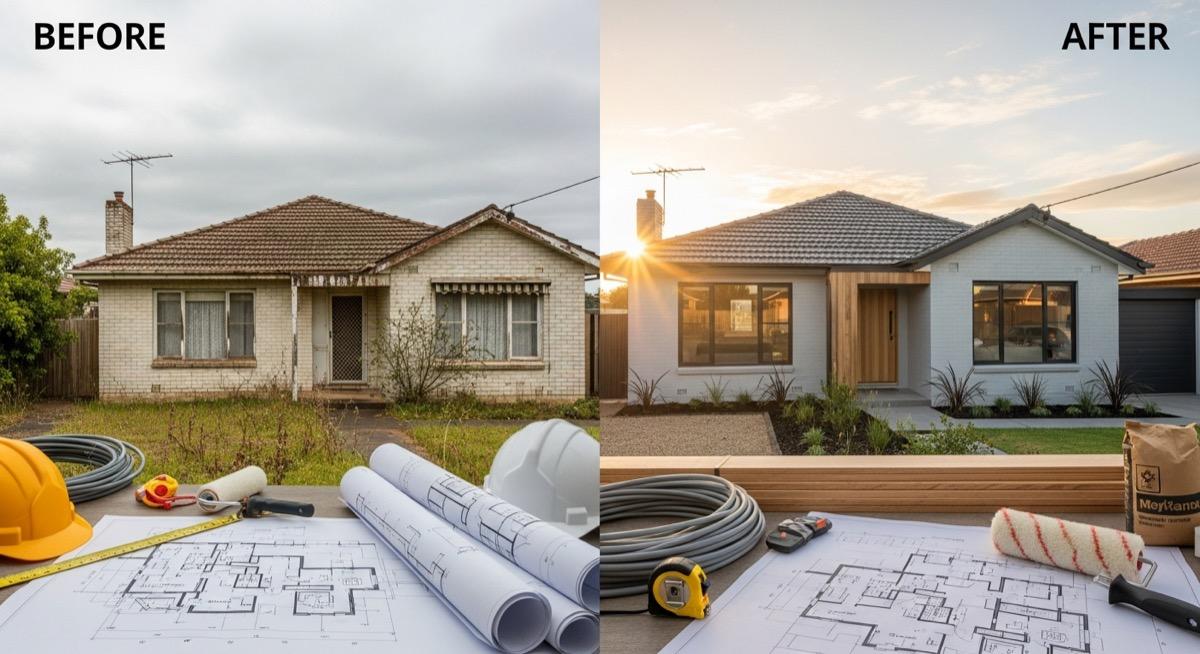
Renovation and Value-Add Property Investment in Australia: How to Calculate Whether a Fixer-Upper Is Worth the Risk in 2026
The promise of renovation investing is seductive: buy an undervalued property, spend strategically on improvements, and walk away with instant equity that took months rather than years to build. In Australia’s 2026 property market — where median house prices in capital cities range from $620,000 in Perth to over $1.4 million in Sydney — the idea of manufacturing growth through renovation has never been more appealing to investors looking for an edge.
But the gap between renovation success and financial disaster is narrower than most investors realise. A $60,000 bathroom and kitchen renovation that adds $120,000 in value is a triumph. The same renovation in the wrong suburb, at the wrong price point, or with the wrong scope can leave you $40,000 underwater before you even factor in holding costs. This guide provides the analytical framework for making that distinction — using data, not instinct.
What Is Value-Add Property Investment?
Value-add investing is any strategy where the investor actively improves a property to increase its market value beyond what was spent on the improvement. This contrasts with passive investment strategies like buy-and-hold capital growth or cash flow approaches, where the investor relies on market forces and rental income rather than physical improvements.
In the Australian context, value-add strategies fall into three broad categories:
Cosmetic renovation: Surface-level improvements that change how a property looks and feels without altering its footprint. This includes painting, new flooring, kitchen and bathroom updates, landscaping, and fixture replacement. Budget range: $15,000–$80,000. Typical timeline: 4–12 weeks.
Structural renovation: Changes that alter the property’s layout, footprint, or configuration. This includes extensions, second-storey additions, converting garages to living space, and internal wall removal. Budget range: $80,000–$350,000. Typical timeline: 3–9 months.
Development and subdivision: Splitting a single lot into multiple titles, building a secondary dwelling (granny flat), or demolishing and rebuilding. Budget range: $100,000–$500,000+. Typical timeline: 6–18 months. This category requires council approval, often involves town planning consultants, and carries the highest risk-reward ratio.
The Renovation ROI Formula: How to Calculate Whether the Numbers Work
Before committing to any renovation investment, you need a framework that strips emotion from the equation. The core calculation is straightforward:
Renovation Profit = After-Renovation Value (ARV) − Purchase Price − Renovation Costs − Holding Costs − Transaction Costs
Let’s break each component down with 2026 numbers.
After-Renovation Value (ARV)
The ARV is the estimated market value of the property once all improvements are complete. This is the most important — and most commonly overestimated — number in the equation. To estimate ARV accurately, you need comparable sales data: recent sales of similar properties in the same suburb that are already in the condition you plan to achieve. Tools like comparable sales analysis are essential here. Look for at least three comparable sales within the past six months and within 500 metres of the target property.
For example, if unrenovated three-bedroom houses in Blacktown, NSW are selling for $780,000–$820,000 and recently renovated equivalents are selling for $920,000–$980,000, you can reasonably estimate an ARV of approximately $950,000.
Renovation Costs
As of Q1 2026, Australian renovation costs have stabilised after the sharp increases of 2022–2024, though they remain 18–25% above pre-pandemic levels. Industry benchmarks from the Housing Industry Association (HIA) and Rawlinsons show:
• Kitchen renovation: $18,000–$45,000 (mid-range) or $45,000–$80,000 (high-end)• Bathroom renovation: $15,000–$35,000 (mid-range) or $35,000–$65,000 (high-end)• Full interior repaint: $8,000–$18,000 for a standard three-bedroom house• New flooring throughout: $12,000–$30,000 depending on material• Landscaping and exterior: $10,000–$40,000• Second-storey addition: $2,800–$4,200 per square metre• Granny flat (60 sqm): $120,000–$180,000 turnkey
Always add a 15–20% contingency buffer. In renovation investing, cost overruns are the rule, not the exception. A $50,000 budget should be modelled as $57,500–$60,000.
Holding Costs
Holding costs are the expenses you incur while the property is being renovated and cannot generate rental income. These include:
• Mortgage interest: On a $780,000 purchase with a 90% LVR at 5.89% (average investor rate, April 2026), monthly interest-only payments are approximately $3,450• Council rates: $350–$600 per quarter depending on LGA• Insurance: $150–$300 per month (construction-phase insurance is more expensive than standard landlord cover)• Utilities: $200–$400 per month during construction
For a three-month cosmetic renovation, holding costs typically total $12,000–$18,000. For a six-month structural renovation, expect $25,000–$40,000. These numbers are frequently overlooked and can turn a marginally profitable renovation into a loss.
Transaction Costs
Don’t forget the costs of buying and (if you plan to sell) selling the property:
• Stamp duty: Varies by state. In NSW on a $780,000 property, approximately $30,500. In Queensland, approximately $21,000. In Victoria, approximately $42,000.• Legal/conveyancing: $1,500–$3,000• Building and pest inspection: $500–$800• Agent commission on sale: 1.8–2.5% of sale price ($17,000–$24,000 on a $950,000 sale)• Marketing costs: $3,000–$8,000
Putting It All Together: A Worked Example
Using our Blacktown example:
• Purchase price: $800,000• Renovation costs (cosmetic, kitchen + bathroom + paint + floors): $65,000 + 15% contingency = $74,750• Holding costs (3 months): $15,000• Transaction costs (stamp duty + legal + inspections): $33,000• Total investment: $922,750• After-renovation value: $950,000• Gross profit: $27,250
That’s a 2.95% return on a $922,750 investment over approximately four months. If you plan to sell, agent commission and marketing ($20,000–$28,000) would wipe out the profit entirely. This example illustrates a critical point: many renovations that look profitable on a napkin fall apart when all costs are included.
Now change the scenario: you find the same unrenovated property for $740,000 (a motivated seller, or a property with cosmetic issues that discourage other buyers). The same renovation at the same ARV produces:
• Total investment: $862,750• After-renovation value: $950,000• Gross profit: $87,250 (10.1% return)
That $60,000 difference in purchase price turned a marginal deal into a strong one. This is why renovation investing is fundamentally about buying well, not renovating well.
The 70% Rule and Other Safety Margins
Experienced renovation investors use the 70% rule as a quick filter: never pay more than 70% of the after-renovation value, minus renovation costs.
Maximum Purchase Price = (ARV × 0.70) − Renovation Costs
Using our example: ($950,000 × 0.70) − $74,750 = $590,250. That’s the maximum you should pay to maintain a healthy margin. Since unrenovated houses in Blacktown start around $780,000, the 70% rule tells you this particular deal doesn’t work for a flip — but may work as a hold-and-renovate strategy where you capture the equity uplift over time rather than crystallising it through an immediate sale.
For hold strategies, a modified rule works better: ensure your renovation spend is recovered at least 1.5× in value uplift. A $75,000 renovation should add at least $112,500 in value. This gives you a buffer against valuation uncertainty and market softening.
Which Renovations Deliver the Best Return in 2026?
Not all renovations are created equal. Based on 2026 valuation data from CoreLogic and bank valuer surveys, here is how different renovation types rank by return on investment:
Tier 1: Highest Return (150–250% ROI)
• Kitchen modernisation: Replacing dated kitchens with modern, neutral-toned equivalents consistently delivers the highest ROI. A $25,000 mid-range kitchen renovation typically adds $40,000–$60,000 in value.• Bathroom renovation: Second only to kitchens. A $20,000 bathroom upgrade adds $30,000–$50,000.• Street appeal and landscaping: First impressions drive valuation. A $10,000 spend on front landscaping, a new front door, and exterior painting can add $20,000–$30,000.
Tier 2: Strong Return (120–150% ROI)
• Internal painting: The single highest-ROI activity per dollar. A $12,000 full repaint adds $18,000–$25,000.• Flooring replacement: Removing carpet and installing vinyl plank or timber-look flooring. A $15,000 spend adds $20,000–$30,000.• Fixture and fitting updates: New tapware, door handles, light fittings, and power points. A $3,000–$5,000 spend adds $8,000–$12,000.
Tier 3: Variable Return (80–150% ROI)
• Granny flat addition: Returns depend heavily on the local government area’s planning rules and the suburb’s rental market. In areas with strong rental demand, a $150,000 granny flat generating $400–$500 per week in rent can deliver excellent long-term returns, but the capital value uplift is often only $100,000–$130,000.• Extensions and second storeys: High cost, variable return. Adding a bedroom and bathroom via extension ($120,000–$200,000) may add only $150,000–$250,000 in value, with significant execution risk.
Tier 4: Low or Negative Return
• Swimming pools: Cost $40,000–$80,000 to install but add only $15,000–$30,000 in value in most suburbs. Pools can actually reduce value in cooler-climate areas.• Over-capitalisation upgrades: Stone benchtops and premium appliances in a suburb where the median price is $650,000 is a common trap. Your renovation should match the suburb’s price ceiling, not exceed it.
Finding the Right Property: What the Data Tells You
The property itself matters less than where it sits in the market. Here are the data signals that indicate renovation potential:
Price Dispersion
Picki data shows that suburbs with high price dispersion — where the gap between the 25th percentile and 75th percentile of sales prices is widest — offer the greatest renovation upside. A suburb where unrenovated houses sell for $600,000 and renovated equivalents sell for $850,000 has a $250,000 spread to work with. A suburb where all houses sell between $700,000 and $780,000 regardless of condition offers minimal renovation upside.
Look for price dispersion of at least 25–30% between the bottom quartile and median in your target suburb. Suburbs like Mandurah in Western Australia — where older housing stock sits alongside newer builds — often display this characteristic.
Days on Market for Unrenovated Properties
When unrenovated properties sit on the market significantly longer than renovated ones (e.g., 60+ days versus 25 days), it signals that buyers in that market place a premium on move-in-ready condition. This is where your renovation spend gets rewarded. We covered how to interpret this metric in our days on market explainer.
Owner-Occupier Demand
Renovated properties sell best in suburbs with high owner-occupier ratios, because owner-occupiers are willing to pay more for presentation and finish quality than investors, who focus primarily on yield. Suburbs with owner-occupier ratios above 65% tend to reward renovation spending more generously.
The Suburb Price Ceiling
Every suburb has an informal price ceiling — the maximum that buyers will pay regardless of how spectacular the property is. Your post-renovation value estimate must sit comfortably below this ceiling. If the highest sale in a suburb in the past 12 months was $980,000, do not assume your renovation will achieve $1.05 million. The market sets the ceiling; your renovation cannot break through it.
The Hold-and-Renovate Strategy: An Alternative to Flipping
Given Australia’s transaction costs (particularly stamp duty), many investors achieve better outcomes by holding renovated properties rather than flipping them. The hold-and-renovate strategy works as follows:
1. Purchase an undervalued property in a growth suburb with strong rental demand2. Renovate to increase both value and rental income — a $50,000 renovation might increase weekly rent from $450 to $5803. Refinance based on the new valuation to extract equity for the next investment4. Hold the property as a higher-yielding asset in your portfolio
This approach avoids selling costs (agent commission, marketing, capital gains tax) and allows you to benefit from both the renovation uplift and ongoing market growth. It’s particularly effective when combined with a thorough cash flow analysis that accounts for the improved rental income post-renovation.
For investors building a portfolio, this strategy can accelerate wealth building significantly. A $100,000 equity extraction through refinancing — achieved through renovation rather than waiting for organic growth — can fund the deposit on a second investment property 2–3 years sooner than a passive approach.
Risk Management: The Pitfalls That Catch Renovation Investors
Renovation investing has a failure rate that rarely gets discussed. Industry estimates suggest 30–40% of renovation projects either break even or lose money for the investor. The most common pitfalls include:
Underestimating costs: The number one cause of renovation losses. Builder quotes are starting points, not fixed prices. Unexpected asbestos, termite damage, plumbing issues, or electrical non-compliance can add $20,000–$50,000 to a budget overnight.
Overestimating ARV: Confirmation bias leads investors to cherry-pick the highest comparable sales and ignore lower ones. Use the median of your comparables, not the top end.
Scope creep: Starting with a cosmetic renovation and gradually expanding to structural changes because “while we’re at it” is the most expensive phrase in property investing.
Ignoring holding costs: Every week of delay costs money. A renovation that runs two months over schedule at $4,000/month in holding costs has just eaten $8,000 of your profit margin.
Wrong suburb selection: Renovating in a suburb where the market doesn’t reward presentation — such as areas dominated by investors focused purely on yield rather than capital value — is a structural mistake that no amount of good renovation work can overcome.
Council and compliance issues: Unapproved work discovered during building inspections, heritage overlays that restrict what you can change, and strata by-laws that limit renovation scope in units and townhouses. Always check zoning and planning constraints before committing.
A Data-Driven Decision Framework
Before committing to a renovation investment, run through this checklist:
☑ ARV confirmed by at least 3 comparable sales within the past 6 months and 500m radius☑ Purchase price is below 75% of ARV (for flips) or below 85% (for hold strategies)☑ Renovation budget includes 15–20% contingency☑ Holding costs modelled for renovation timeline plus 2-month buffer☑ Suburb price dispersion exceeds 25% between bottom quartile and median☑ Days on market for unrenovated properties is 40+ days longer than renovated equivalents☑ Building and pest inspection completed (non-negotiable — never buy a renovation property without one)☑ Council check completed for heritage overlays, flood zones, and planning restrictions☑ Finance pre-approved with construction or renovation loan facility in place☑ Exit strategy defined: hold and refinance, or sell within 12 months
If you cannot tick every box, the deal carries more risk than the potential return justifies. Walk away and wait for a better opportunity. Renovation investing rewards patience and discipline far more than enthusiasm.
Getting Started: Where to Find Renovation Opportunities
The best renovation opportunities share common characteristics: they are cosmetically tired but structurally sound, they sit in suburbs where presentation commands a premium, and they are priced below the suburb median because their current condition discourages owner-occupier buyers.
Start by identifying suburbs that match your budget and strategy using Picki’s suburb comparison tools. Filter for areas with strong owner-occupier demand, healthy price dispersion, and low days on market for renovated properties. Then monitor new listings in those suburbs, looking specifically for properties described with agent code words like “potential,” “original condition,” “renovator’s delight,” or “blank canvas.”
Remember: the renovation itself is the easy part. The hard part — and the part that determines whether you make money — is the analysis that happens before you buy.
Frequently Asked Questions
How much should I spend on renovating an investment property?
As a general rule, your total renovation spend (including contingency) should not exceed 10% of the property’s after-renovation value for cosmetic work or 20% for structural renovations. For a property with an ARV of $900,000, that means a cosmetic renovation budget of $90,000 maximum. Always ensure the expected value uplift exceeds your spend by at least 1.5× for hold strategies or 2× for flip strategies.
Is it better to flip or hold a renovated investment property?
In Australia’s current market, holding generally outperforms flipping due to high transaction costs. Stamp duty alone can consume 3–5% of the purchase price, and agent commission takes another 2–2.5% on sale. A hold-and-refinance strategy avoids these costs while allowing you to benefit from both the renovation equity uplift and ongoing capital growth. Flipping only makes sense when the margin is large enough (20%+ gross profit) to absorb all transaction costs and still deliver a meaningful return.
What are the biggest mistakes renovation investors make?
The three most costly mistakes are: (1) overestimating the after-renovation value by using best-case comparable sales rather than conservative estimates, (2) underestimating renovation costs by failing to include a contingency buffer and holding costs, and (3) choosing the wrong suburb — specifically, renovating in a market where buyers do not pay a premium for presentation quality. A fourth common mistake is scope creep: starting with a $40,000 cosmetic renovation and gradually expanding to $120,000 in structural work without reassessing the business case.
How do I estimate the after-renovation value of a property?
Use comparable sales analysis: find at least three recently sold properties (within 6 months) in the same suburb that match the condition, size, and configuration your property will have after renovation. Use the median of these sales as your ARV estimate, not the highest. Online valuation tools can provide a starting point, but bank valuers and local real estate agents who specialise in the area will give more accurate estimates. Never rely on a single data source.
Can I claim renovation costs as tax deductions on an investment property?
It depends on the type of work. Repairs (restoring something to its original condition) are immediately deductible. Improvements (upgrades that enhance the property beyond its original state) are capital expenses that must be depreciated over time. For example, replacing a broken tap is a repair (deductible), but installing a new kitchen is an improvement (depreciated). A quantity surveyor can prepare a depreciation schedule that maximises your legitimate tax deductions across both categories. This distinction can significantly affect your after-tax return.