

How to Read Building Approval Data: What New Development Activity Tells You About a Suburb's Future
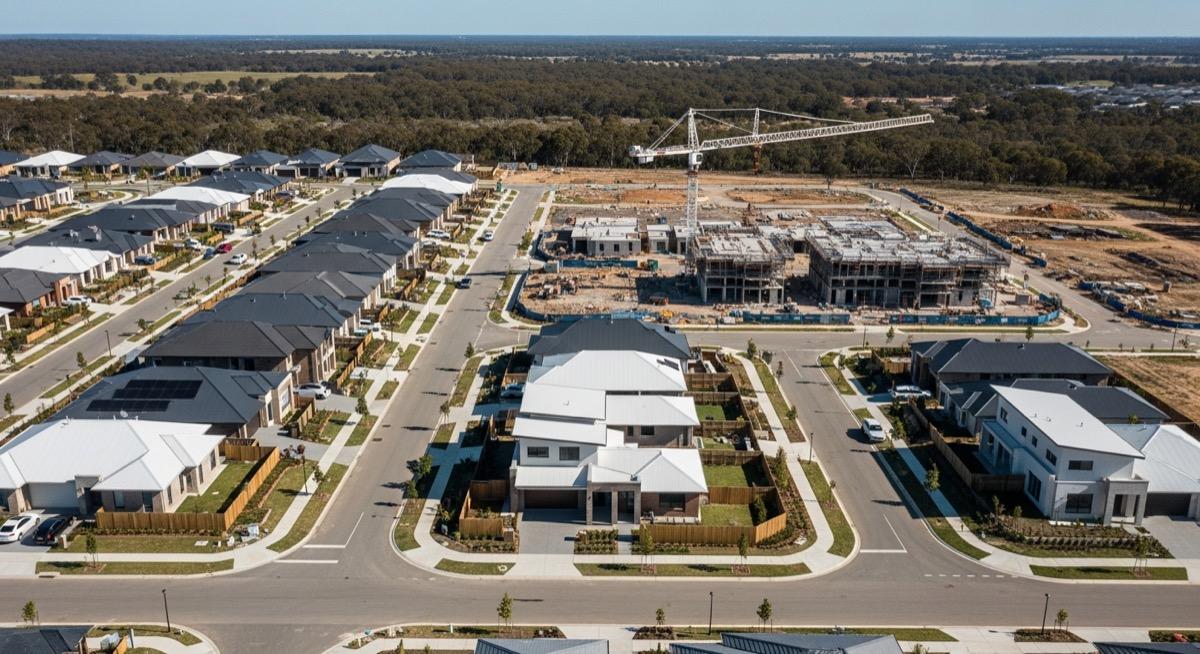
Building approvals data is one of the most underused leading indicators in Australian property research. While most investors fixate on median prices and rental yields — which are lagging indicators — building approvals tell you what's coming next. They reveal the supply pipeline that will either relieve pressure on rents and prices in two to three years, or quietly choke a market that already can't keep up with demand. Understanding how to read this data is the difference between buying into a suburb that looks good today and buying into a suburb that will still look good in 2029.
Key Takeaways
- Building approvals are a leading indicator — they show supply that will hit the market in 18–36 months, well before it affects prices or rents.
- The Australian Bureau of Statistics (ABS) releases monthly building approvals data by Local Government Area (LGA), covering houses, units, townhouses, and non-residential dwellings.
- A high approvals-to-stock ratio signals future supply pressure; a low ratio signals a potential squeeze on rents and prices.
- Context matters: a suburb with strong population growth can absorb high approvals, while a stagnant suburb cannot.
- Picki data shows the suburbs with the tightest supply pipelines in 2026 are not always the ones making headlines — many are quiet, established regional markets.
What is building approvals data?
Building approvals data is published monthly by the Australian Bureau of Statistics in its Building Approvals, Australia release (catalogue 8731.0). It captures every residential and non-residential construction project that has received approval from a local council or private certifier. The dataset is available at the national, state, Statistical Area (SA2, SA3, SA4), and Local Government Area (LGA) level, which makes it usable for suburb-level research when combined with geographic mapping.
Each approval represents a dwelling that has cleared the planning hurdle but has not yet been built. The gap between approval and completion is typically 12 to 24 months for houses and 24 to 36 months for medium and high-density dwellings. That lag is exactly why the data is valuable: it gives you a window into the supply pipeline before it arrives.
The data is broken down by dwelling type — separate houses, semi-detached and townhouses, and flats/apartments/units — which matters enormously for investors. A suburb with 400 approved apartments in a single tower tells a completely different story to a suburb with 400 approved separate houses spread across five new estates.
Why building approvals matter for property investors
Property markets are governed by supply and demand. Most investors research the demand side obsessively — population growth, rental yields, vacancy rates, school catchments — but ignore the supply side until it's too late. Building approvals are the earliest signal you can get on the supply side of the equation.
Here's why that matters. When approvals surge in a suburb, the market typically sees:
- 18–36 months later: New stock hits the market as construction completes.
- Downward pressure on rents if supply outpaces tenant demand.
- Softening capital growth as buyers gain more options.
- Compression of yields as prices hold but rents stall.
Conversely, when approvals collapse or stay persistently low in a suburb with growing population, the opposite happens: rents tighten, vacancy rates fall, and prices tend to outperform. This is the pattern behind many of Australia's tightest rental markets in 2026, where a decade of under-building has created structural supply shortages that are now showing up in record-low vacancy rates.
How to read the numbers
Raw approval counts are almost useless without context. A suburb with 200 approvals per year sounds like a lot until you realise it has 40,000 existing dwellings — an annual supply growth rate of 0.5%, which is well below typical population growth. The metrics that actually matter are:
1. Approvals-to-stock ratio
This is the number of approvals in a given period divided by the existing dwelling stock. A ratio above 2% per year is aggressive — it means the suburb is adding new housing faster than most populations grow. A ratio below 0.5% is restrictive and typically correlates with tightening supply. The sweet spot for investors is usually a suburb growing at 0.8–1.5%, where new supply keeps pace with demand without overwhelming it.
2. Dwelling mix
Are the approvals dominated by apartments, townhouses, or separate houses? This matters because different dwelling types serve different markets. A flood of one-bedroom apartments in a family-oriented suburb won't compete with three-bedroom houses, but it will saturate the local rental market for singles and couples. Our guide to how dwelling type affects investment performance goes deeper on this dynamic.
3. Trend direction
A single month of high approvals is noise. A 12-month rolling average trending upward is signal. Look at the trajectory over the past three years, not the last release. Monthly ABS data is notoriously volatile — a single large apartment project can double a suburb's approval count for one month without changing the underlying trend.
4. Approvals vs completions
Not every approval gets built. In tight financing environments, developer approval-to-completion rates can drop below 70%, meaning a third of the approved pipeline never arrives. Tracking both approvals and actual commencements (also in the ABS release) gives you a more realistic picture of what's actually coming.
What high approvals can signal
High approval activity is not automatically bad. It can mean:
- The suburb is in demand — developers don't build where they can't sell.
- Infrastructure is being unlocked — new rail, roads, or town centres often trigger approval waves.
- Population growth is being met — which keeps the area functional and liveable long-term.
- Rezoning has occurred — medium-density uplift in established suburbs.
However, it can also signal oversupply risk — especially in apartment-heavy markets where the pipeline outruns genuine tenant demand. The Melbourne and Brisbane inner-city apartment markets in 2015–2019 are the textbook examples: strong approvals for years, followed by a multi-year period of stagnant rents and discounted off-the-plan sales.
What low approvals can signal
Persistently low approvals in a suburb with positive population growth is one of the strongest bullish signals in property research. It indicates:
- Planning constraints (heritage overlays, flood zones, height limits).
- Geographic constraints (landlocked suburbs, coastal fringe, surrounded by parks or infrastructure).
- Ownership concentration (large single-owner holdings that aren't being subdivided).
- Market conditions unfavourable to developers (construction costs, finance, buyer sentiment).
This is the supply-constrained profile that drives long-term capital growth. Established bayside, inner-ring, and geographically locked regional suburbs often show this pattern. It's one of the reasons Kirwan QLD and similar established regional centres have performed strongly — genuine demand meeting a relatively fixed housing stock.
Putting it in context: population and jobs
Supply data in isolation is misleading. You need to overlay it with demand data to get a real read. The key demand indicators to combine with approvals are:
- Population growth rate: If a suburb is adding 2% population per year and only 1% housing stock, pressure is building.
- Household formation: Smaller households (singles, couples, divorcees, downsizers) consume more dwellings per capita.
- Job growth: Suburbs near employment centres or infrastructure corridors absorb supply faster.
- Vacancy rates: The real-time pressure gauge. Approvals predict pressure 18–36 months out; vacancy tells you what's happening now.
The combination tells the story. A suburb with 1.5% population growth, 0.7% approvals-to-stock ratio, and a 0.8% vacancy rate is a tightening market regardless of what the median price says. A suburb with 0.3% population growth and 2.5% approvals-to-stock ratio is heading for oversupply even if today's yields look attractive.
Regional vs metro supply pipelines
Metropolitan and regional supply pipelines behave very differently. Metro suburbs — especially in Sydney, Melbourne, and Brisbane — are dominated by medium and high-density approvals, which are lumpy (a single 300-unit tower distorts everything) and sensitive to development finance conditions. Regional suburbs are dominated by separate house approvals, which are more stable and closely track local population and council-led land release programs.
According to Picki's analysis of 2024–2025 data, regional markets with under 1% annual approvals-to-stock ratios have consistently outperformed metro markets with 2%+ ratios on five-year total return. This is one of the dynamics explored in our piece on regional vs metro property investment in 2026.
How Picki uses building approvals data
Picki integrates ABS building approvals data at the LGA level and contextualises it against suburb-level population, vacancy, and stock data. Rather than publishing a raw approvals number — which most investors can't interpret without benchmarks — Picki translates it into a supply-pressure signal: is this suburb's pipeline heavier, lighter, or in line with its demand fundamentals?
We pair it with vacancy, rental trend, and demographic data so that the supply story sits inside the full market picture. A high approvals reading gets flagged differently depending on whether it's absorbing genuine demand or outrunning it. You can see how this plays out at the council level on any LGA page, which aggregates approvals and stock data across constituent suburbs.
Practical research workflow
Here's how to actually use building approvals data when shortlisting suburbs:
- Start with demand: population growth, vacancy rate, rental trend over three years.
- Layer in the approvals-to-stock ratio: is it above, below, or in line with the state average?
- Check the dwelling mix: does the pipeline match the suburb's existing profile?
- Look at the trend: is the pipeline ramping up, winding down, or stable?
- Cross-check with comparable suburbs using a side-by-side comparison. Our guide to comparing suburbs using data walks through this process.
Most investors will find that this single additional layer — supply pipeline awareness — reshapes their shortlist significantly. Suburbs that look good on yield and growth alone sometimes reveal a worrying pipeline; suburbs that look middling on surface metrics sometimes reveal a supply squeeze that explains years of outperformance.
Common mistakes when reading approvals data
- Using one month of data. ABS monthly releases are volatile. Always use rolling 12-month figures.
- Ignoring dwelling mix. 500 apartment approvals and 500 house approvals mean very different things.
- Comparing raw counts across suburbs of different sizes. Always use the ratio, not the count.
- Treating approvals as completions. Not everything gets built, especially in tight finance cycles.
- Forgetting the demand side. Supply without demand context is just a number.
The bottom line
Building approvals data tells you what the property market will look like in two to three years, not what it looks like today. That's exactly why it matters. Most investors buy based on what they can see — the yield, the growth, the vacancy rate — and wonder later why the market turned. The ones who also read the supply pipeline are rarely caught out.
If you want to see how supply data, vacancy, yield, and demographic signals stack up across any Australian suburb you're researching, you can browse suburb reports and pull the numbers side-by-side.
Frequently Asked Questions
Where does building approvals data come from?
The Australian Bureau of Statistics publishes monthly building approvals data in its catalogue 8731.0 release. It covers every residential and non-residential building project approved by councils and private certifiers, broken down by state, region, LGA, and dwelling type.
How long does it take for an approved dwelling to be built?
Separate houses typically take 12 to 24 months from approval to completion. Medium and high-density dwellings (townhouses, apartments) generally take 24 to 36 months, though large apartment towers can take longer. Not every approval gets built — developer completion rates vary between 70% and 90% depending on finance and market conditions.
What's a healthy approvals-to-stock ratio?
Most balanced markets sit between 0.8% and 1.5% annual approvals-to-stock ratio. Below 0.5% typically signals supply constraints; above 2% suggests aggressive supply growth that needs to be matched by strong population and household formation.
Are high building approvals always bad for property prices?
No. High approvals in a suburb with strong population growth and employment can be absorbed without harming prices. High approvals are a problem when they outpace genuine tenant and owner-occupier demand — most commonly in apartment-heavy submarkets.
How does Picki use building approvals data in its suburb analysis?
Picki integrates ABS approvals data at the LGA level and contextualises it against suburb-level population, vacancy, and stock data. Rather than showing raw numbers, Picki translates approvals into a supply-pressure signal that sits alongside demand, yield, and growth indicators, so investors can see the full picture at a glance.