

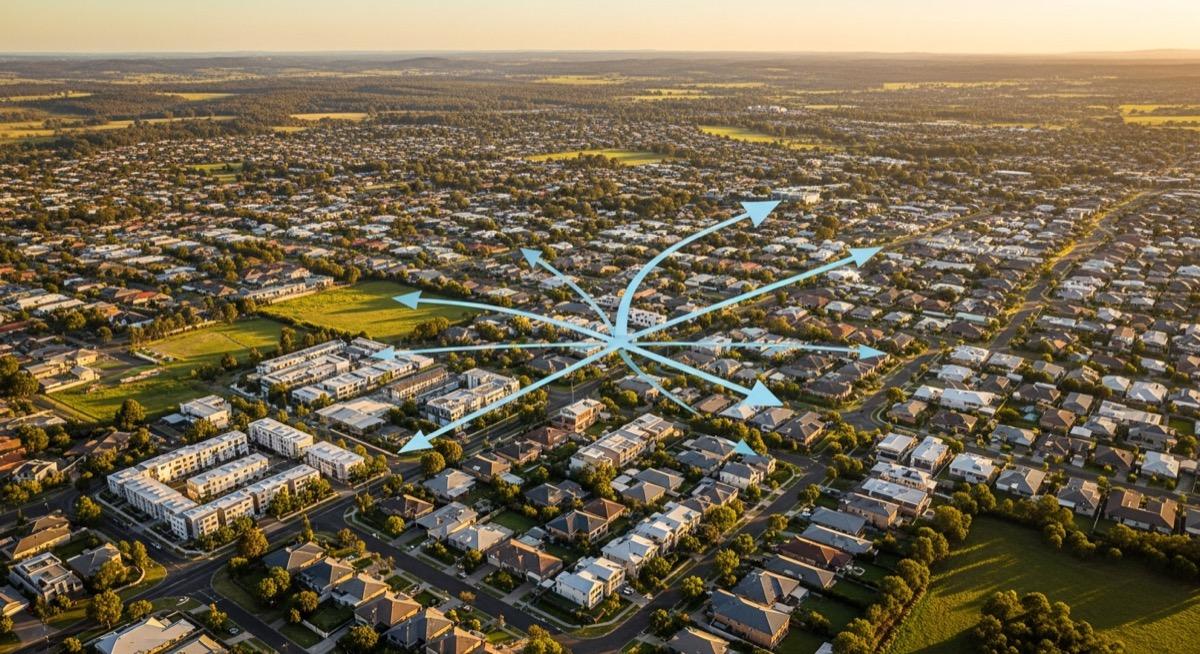
Interstate Migration and Property Investment in Australia: How Affordability-Driven Population Shifts Are Creating Opportunity in 2026
In April 2026, Productivity Commission chair Danielle Wood confirmed what the data has been showing for years: young Australians are leaving Sydney "en masse" because they simply cannot afford to live there. This isn't just a social trend — it's a structural shift in where property demand is heading, and savvy investors are paying attention.
Interstate migration has always influenced Australian property markets. But the scale and speed of current population movements — driven by remote work flexibility, housing affordability gaps, and lifestyle preferences — are reshaping which suburbs and regions offer the strongest investment fundamentals. Understanding these migration patterns isn't optional for property investors in 2026. It's essential.
Key Takeaways
- Net interstate migration from NSW to Queensland averaged 30,000+ people per year from 2021 to 2025, creating sustained demand in SEQ corridors.
- Victoria experienced net outflows of approximately 15,000 people annually from 2023 to 2025, though inner Melbourne has begun stabilising in 2026.
- Western Australia recorded its highest net interstate migration in over a decade during 2025, driven by resources sector employment and relative affordability.
- Regional areas within 90 minutes of capital CBDs consistently outperform remote regional areas for migration-driven demand.
- Picki data shows suburbs with above-average population growth scores tend to also exhibit stronger rental demand and lower vacancy rates.
Why Interstate Migration Matters for Property Investors
Population growth is the single most fundamental driver of housing demand. More people in an area means more competition for housing — both rental and owner-occupied — which puts upward pressure on prices and rents. But not all population growth is equal. Natural population increase (births minus deaths) tends to be gradual and predictable. Interstate migration, by contrast, can shift dramatically in response to economic conditions, policy changes, and affordability thresholds.
For property investors, interstate migration data provides a leading indicator of future demand. When thousands of people move from one state to another, they need housing immediately — first as renters, then often as buyers. This creates a measurable sequence: vacancy rates tighten, rents increase, and eventually purchase prices follow.
The Australian Bureau of Statistics (ABS) tracks interstate migration quarterly, and the patterns from 2023 to 2026 tell a clear story about where demand is building.
The Big Picture: State-by-State Migration Flows in 2026
New South Wales: The Great Outflow
New South Wales has been a net loser of interstate migrants since 2020, and the trend accelerated through 2025. ABS data shows NSW lost a net 33,400 residents to other states in the year to September 2025 — the largest annual outflow since records began. Sydney's median house price exceeding $1.5 million has created an affordability ceiling that pushes younger households toward Queensland, Western Australia, and South Australia.
This doesn't mean Sydney is a poor investment market. Reduced new supply (dwelling approvals in NSW fell 8.3% year-on-year in 2025) and persistent international migration into Sydney mean certain suburbs — particularly those in the Blacktown corridor and south-west growth areas — continue to see demand from new arrivals even as domestic residents leave.
Queensland: The Primary Beneficiary
Queensland has been Australia's top destination for interstate migrants for four consecutive years. Net interstate migration into Queensland averaged 31,200 people per year from 2022 to 2025. South East Queensland (SEQ) absorbs the majority, with the Gold Coast, Sunshine Coast, Moreton Bay, and Logan LGAs seeing the strongest inflows.
The Brisbane 2032 Olympics infrastructure pipeline — estimated at over $7 billion in transport, venues, and urban renewal — is amplifying this migration effect. Suburbs within SEQ's emerging transport corridors are experiencing both population growth and infrastructure-driven demand growth simultaneously, a combination that historically produces strong medium-term capital growth.
Regional Queensland is a different story. While the Townsville corridor (including suburbs like Kirwan) benefits from defence spending and resources sector employment, more remote regional areas have not captured the same migration volumes. Investors need to be selective.
Western Australia: The Quiet Surge
Western Australia recorded net interstate migration of approximately 12,800 people in 2025 — its highest figure since the mining boom era of 2012-2013. Unlike the mining boom migration, which was heavily concentrated in resources towns, current migration is flowing primarily into Perth's northern and southern corridors and the Mandurah region.
Perth's median house price remains approximately 40% below Sydney's and 25% below Melbourne's, making it attractive to eastern states migrants seeking a combination of lifestyle, employment, and housing affordability. The resources sector is providing employment stability, but it's affordability — not mining — driving the current wave.
Victoria: Stabilisation After the Exodus
Victoria lost a net 15,200 interstate residents in 2025, continuing a trend that began during the extended COVID lockdowns of 2020-2021. However, quarterly data from late 2025 suggests the outflows are slowing. Melbourne's inner ring has begun stabilising, with returning international students and overseas migrants partially offsetting domestic departures.
For investors, Melbourne's current position presents a contrarian opportunity. Vendor discounting in Melbourne has been among the highest of any capital city, meaning negotiation leverage for buyers. If interstate outflows continue to moderate — as the data suggests — the supply-demand balance could shift faster than the market expects.
South Australia and Tasmania: Niche Opportunities
South Australia has quietly recorded positive net interstate migration since 2023, with Adelaide's relative affordability (median house price under $750,000) attracting both retirees and young professionals. Tasmania, meanwhile, has seen its COVID-era migration boom fade, with the state returning to near-zero net interstate flows by 2025.
How Migration Data Translates to Investment Decisions
Raw migration numbers tell you where people are going. But turning that into an investment thesis requires looking at several additional factors simultaneously.
1. Absorption Capacity
A suburb or LGA receiving new residents can only sustain price growth if housing supply doesn't expand fast enough to absorb the demand. This is why migration data must be read alongside dwelling approval figures and construction pipeline data. An area receiving 5,000 new residents per year but also approving 4,000 new dwellings may see muted price effects, while an area receiving 2,000 residents with only 500 approvals will experience acute demand pressure.
Picki's population growth vs new supply metric captures exactly this dynamic, comparing incoming demand against the construction pipeline.
2. Renter-First Migration
Interstate migrants typically rent for 6 to 18 months before purchasing, if they purchase at all. This means migration-driven demand hits the rental market first. Suburbs with already-tight vacancy rates that are also receiving migration inflows face compounding demand pressure. According to Picki's analysis, suburbs where the population score exceeds 70 and the vacancy rate sits below 2% tend to exhibit the strongest rental growth trajectory.
3. Employment Anchors
Migration flows are sustainable only when supported by employment opportunities. The Productivity Commission's April 2026 report highlighted that construction productivity has fallen 12% over the past three decades, contributing to housing undersupply. But it also noted that employment diversity is critical for regional resilience. Suburbs anchored by a single employer or industry are vulnerable to migration reversals if that employer downsizes.
4. Infrastructure Timing
Migration often follows infrastructure announcements, but the investment opportunity typically exists before the infrastructure is completed. The SEQ Olympic corridor, Perth's METRONET extensions, and Adelaide's north-south corridor upgrades are all examples where committed infrastructure spending is attracting migration that hasn't yet been fully priced into property values.
Practical Framework: Using Migration Data in Your Research
Here's a step-by-step approach to incorporating interstate migration patterns into your property investment analysis:
Step 1: Identify net migration direction. Start with ABS quarterly interstate migration data to identify which states and regions are gaining residents. Focus on sustained trends (3+ consecutive quarters of positive net migration) rather than single-quarter spikes.
Step 2: Drill down to LGA level. State-level data is too broad for investment decisions. Use LGA-level pages on Picki to understand which local government areas within gaining states are absorbing the most population growth.
Step 3: Cross-reference with supply data. Check dwelling approvals and the construction pipeline for your target LGAs. High migration + low supply = demand pressure. High migration + high supply = potentially neutral.
Step 4: Assess rental market conditions. Look at vacancy rates, gross and net yields, and days on market for rentals. Migration-driven demand should show up as falling vacancy rates and rising rents before it shows up in purchase prices.
Step 5: Evaluate sustainability. Ask what's driving the migration. Affordability arbitrage (people moving because it's cheaper) is real but has limits — once the destination becomes expensive, the flow redirects. Employment-driven migration (people moving for jobs) tends to be more durable.
Where the Data Points in 2026
Based on current migration trends, population data, and supply-demand fundamentals, several corridors warrant close attention from investors:
South East Queensland (Moreton Bay, Logan, Ipswich LGAs): Sustained interstate inflows, Olympics infrastructure pipeline, relatively affordable compared to Gold Coast and Brisbane inner ring. Suburbs with strong transport connectivity and comparative advantages in affordability within SEQ are worth examining.
Perth northern corridor (Wanneroo, Joondalup): Interstate migration surge, employment diversification beyond resources, significant infrastructure investment in METRONET and road upgrades.
Adelaide northern suburbs (Salisbury, Playford): Positive net migration, defence sector employment growth (AUKUS submarine program), and median prices below $500,000 providing strong cashflow metrics.
Melbourne's western growth corridor (Tarneit, Truganina, Wyndham Vale): While Victoria is losing residents overall, these suburbs continue to grow through a combination of international migration and natural increase. If interstate outflows moderate as expected, these areas could benefit from a double tailwind.
The Risk: When Migration Reverses
Every migration trend eventually slows, and some reverse entirely. The COVID-era sea change to regional areas is a cautionary example — many regional towns that saw explosive growth in 2020-2021 have since experienced flat or falling prices as the migration flow normalised.
Investors should be cautious about:
- Single-driver migration: Areas attracting residents solely due to affordability (without employment or lifestyle anchors) are vulnerable to reversal once prices catch up.
- Overbuilding risk: Growth corridors that have attracted significant developer activity may see supply catch up with demand faster than expected.
- Data lag: ABS migration data is released with a 6-9 month lag. By the time a trend is confirmed in official data, early-mover investors have already acted.
This is why using forward-looking indicators — like the R-Score and population growth metrics available through Picki's suburb analysis tools — provides an edge over relying solely on backward-looking government statistics.
Frequently Asked Questions
Which Australian state is gaining the most residents from interstate migration in 2026?
Queensland remains the top destination for interstate migrants in 2026, with net inflows averaging over 30,000 people per year since 2022. South East Queensland — particularly the Gold Coast, Moreton Bay, and Logan LGAs — absorbs the majority of these new residents. Western Australia has also seen a significant surge, recording its highest net interstate migration since 2012-2013.
How does interstate migration affect property prices and rents?
Interstate migration creates immediate rental demand (as most migrants rent initially) and delayed purchase demand. In areas where housing supply is constrained, this manifests as falling vacancy rates, rising rents over 3-6 months, and eventual upward pressure on purchase prices over 12-24 months. The effect is strongest in suburbs where population growth outpaces new dwelling supply.
Is it too late to invest in Queensland based on migration trends?
While Queensland has been a migration hotspot for several years, the opportunity varies significantly by suburb and LGA. Inner Brisbane and the Gold Coast beachside strip have already priced in much of the migration premium. However, outer SEQ corridors — particularly in Moreton Bay, Logan, and Ipswich — still offer relative value, especially for investors focused on cashflow-positive strategies. The key is finding suburbs where demand growth still outpaces supply.
How can I track interstate migration data for property investment research?
The ABS publishes quarterly interstate migration estimates as part of the National, State and Territory Population release (catalogue 3101.0). For suburb-level analysis, Picki provides population growth scores and supply-demand metrics that translate macro migration data into actionable suburb-level insights. Combining both sources gives you the most complete picture.
Does interstate migration always lead to property price growth?
No. Migration must be considered alongside supply, employment sustainability, and affordability headroom. Areas receiving strong migration but also experiencing a building boom may see muted price effects. Similarly, migration driven purely by affordability (without employment anchors) can reverse once prices rise. Sustainable price growth typically requires migration supported by diversified employment, constrained supply, and infrastructure investment.
Ready to see how migration trends are affecting specific suburbs? Explore Picki's suburb analysis tools to compare population growth scores, vacancy rates, and supply metrics for any Australian suburb.